Can Generative Artificial Intelligence Perform Clinical Reasoning?
Vijay Vamja
8-10 mins
The healthcare industry is leading the AI adoption race, faster than adopting EHRs. Applications of Generative artificial intelligence, particularly with clinical reasoning, are being implemented in healthcare globally, whether through internal development teams, big tech companies, or by procuring solutions from vendors.
In the seemingly flooded market of generative AI tools, with most running proof of concept (POC), at scale implementations are yet scarce. However, it's not stopping the healthcare organizations. About 60% executives report that their AI budget spendings exceed IT infrastructure budgets.
Hence, this blog explores the concept of clinical reasoning in healthcare and how generative AI handles it to drive clinical reasoning and predictive probability reasoning. Can AI now really work in tandem with physicians and clinicians on AI reasoning? Let's learn!
Hint: GenAI performs clinical reasoning marvelously, with a handful of caveats.
What is Clinical Reasoning?
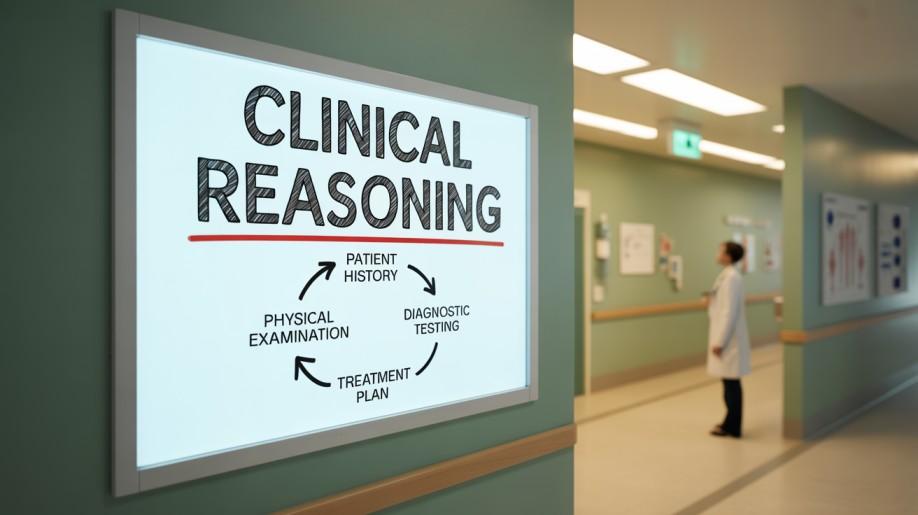
Clinical reasoning is a process where a physician or clinician interacts with the patient and collects their vital information to test hypotheses or determine optimal diagnosis and treatment.
Often, this clinical reasoning definition is also viewed as:
Another, more simplistic definition of clinical reasoning also describes it as the 'sum of thinking and decision-making process associated with clinical practice.'
While in theory the process seems linear, in practice it is inclusive of errors of various types because it's a cognitive process. Figuratively, this implies that the ability of clinical reasoning will differ slightly or sporadically from one clinician to another.
Since the ability to reason, especially to make diagnoses, is considered a central and critical competency in medical practice, a general model of diagnostic reasoning in physicians is developed. This model, termed as the hypothetico‑deductive model, encompasses specific cognitive processes and knowledge structures organized in long‑term memory.
Let's briefly overview this model and other concepts connected to clinical reasoning, to better understand the overall complexities.
The Hypothetico-Deductive Model
Since the late 1970s, clinical reasoning or human problem solving has followed the hypothetico‑deductive model.
Within this model, physicians generate one or more diagnostic hypotheses in the very first seconds or minutes of an encounter. Next, they confirm or refute these hypotheses through data gathering guided by those very hypotheses.
The process of generating hypotheses fundamentally demands having a cognitive process and knowledge of the particular speciality. Still, there is also always a possibility that physicians can be wrong, and this is where AI pulls the lead, perhaps? Let's see.
Cognitive Processes
The cognitive process refers to how information is processed, stored, and used to support human/clinical reasoning. It relies mainly on two factors:
- Intuitive Process
Reasoning occurs rapidly but below the threshold of consciousness by using very little information. Clinicians are known to use it for generating diagnostic hypotheses quickly and effortlessly.
- Analytical Process
Information is consciously processed in a more systematic manner, often by gathering large or exhaustive data about the patient. Thereon, relative possible diagnoses are developed, and this process is again used to validate compatibility of the data.
Knowledge
In simple terms, knowledge powers the reasoning processes mentioned above, wherein it exists in two possible states, i.e. prototypes & scripts.
- Prototypes:
It deals with the associations of two to four clinical and/or contextual cues that, when present together, strongly suggest one or more hypotheses.
For example, The associations “cough—fatigue—weight loss—smoking,” are prototypes of pulmonary neoplasm.
It must be noted that with all the knowledge, possessing experience plays a significant role in building strong prototypes.
- Scripts:
These are sequences of slots to be filled so the generated hypotheses can be confirmed, refuted or followed-up with effective action.
In the intuition triggered hypothesis based on prototype recognition, the brain activates corresponding script to cue the clinician about looking for a particular element. These elements can be modeled as slots to fill, that are then compared against expected value.
For example, in the pulmonary neoplasm condition stated above, activated slots can be “past history,” “constitutional symptoms,” and “blood cultures.”
Thus, if the data is incompatible with expectations, the script closes and the hypothesis is rejected. Otherwise, if enough slots are filled with expected values, the hypothesis is confirmed.
Introduction to Generative AI-Based Clinical Reasoning
What does it mean for a computer to think like a doctor?
This question is not new as both developers and physicians have been working on achieving clinical reasoning in AI for over 70 years.
But in 2025, we now have the answer, and it's solving the various challenges in healthcare, too.
The advanced “computerised” reasoning is based on standardised large volumes of health data collection, and probabilistic inference performed via established neural networks.
Findings from the reasoning are then delivered using generative AI components, making interactions possible between AI to patients, and AI to physicians.
Hence, artificial intelligence today holds the capacity to handle & perform clinical reasoning through its self-learning, understanding, and decision-making capabilities, aiming to assist physicians and clinicians.
Let's explore the fundamental characteristics of artificial clinical reasoning without further ado, since modern AI with clinical reasoning already empowers entire healthcare teams across regions.
Key Characteristics of Artificial Clinical Reasoning
The extraordinary ability to generate pertinent hypotheses extremely rapidly, effortlessly, and with very little information is common in humans and artificial intelligence. In some situations, however, physicians can be wrong, and it's human, too, here's where GenAI with reasoning can lead teams.
1. AI Reasoning Works Inductively
For attaining functional everyday performance, machines must regularly ingest large data, using which they group patterns and infer hypotheses. Since AI systems by design are incapable of intuition, their overall mode of operating inverts the human approach
GenAI systems progress from data to solution, which is why modern machines outperform humans in diagnostic tasks where data is immediately accessible. Good examples of this truth can be found in analyzing CT or pathology images.
In other diagnostic activities, the performance internists exceed the self-diagnosis capabilities of AI tools available for public-use.
2. AI Hypothesizes In High Volumes
The computing power of modern AI machines is exponentially higher than the human brain. For perspective, it's cited that a human brain can handle up to seven diagnostic hypotheses.
In emergency medicine, physicians generate five hypotheses on average during initial evaluation. Contrastingly, a machine can theoretically pursue unlimited hypotheses.
Consider a patient with a painful knee. In this scenario, a machine could consider dozens of possible causes whereas a clinician will focus on one or few intuitively generated hypotheses.
3. AI Does Not Err & Works Consistently
Training an AI system is lengthy and costly, however the costs can be mitigated by training on high-quality data. Not only could the error rates be estimated precisely and driven down considerably, but it will also produce similar output for the same problem every time.
Physicians, on the other hand, can continue making mistakes even as experts. Their reasoning is sensitive to numerous contextual factors such as fatigue, cognitive overload, interruptions, noise, and emotions.
4. AI Diagnosis Techniques Are Kept Secret
Certain interviewing techniques enable understanding quite precisely how a physician can arrive (cognitively) at a given diagnosis, even in error.
In comparison, the AI techniques of neural networks carry a ‘black-box’ effect, making it often impossible to view or explain how a result is obtained.
One may think this is a critical ethical and a legal issue, work is ongoing to overcome this limitation, and the latest LLM models have, indeed, optimized it.
5. AI Lacks General Intelligence
The artificial intelligence technologies today parallel or exceed several human cognitive abilities, like solving clinical problems. In specific situations, GenAI can also achieve high-level performance, but it cannot be considered intelligent.
AI machines do not understand what it is doing or the result it produces in a general context. It can only perform a sequence of mathematical operations in line with its design and trained function. Therefore, despite lacking a general reasoning mechanism, it dedicatedly solves a single, well-defined problem.
Types of Generative Artificial Intelligence Reasoning Errors
Clinicians misdiagnose in nearly one out of six cases, and within internal medicine, three-quarters of such errors stem from reasoning failure, often attributed to cognitive biases.
There are hundreds of biases, especially in diagnostic error, with the following being witnessed commonly.
1. Premature Closure
It is the leading cause of diagnostic error in internal medicine that prevents continuous data collection (i.e. leaving script slots unfilled) by concluding too early.
Often, the generative AI will declare the working hypothesis is correct by abruptly or prematurely closing reasoning chain algorithms. While this is a critical flaw, it can be prevented altogether by fine-tuning the LLM model to follow a no-premature closure and other similar rules.
2. Anchoring Bias
When the generative AI fixates too early on summary or salient features of initial presentation, it also fails to revise the first impressions and findings. In this process, the subsequently gathered data, although valuable, loses its worth by not being included within the reasoning process.
3. Availability Bias
Generative AI within AI reasoning (for several unknown reasons) overestimates the likelihood of diagnoses that are easier to call. For example, the recently made deductions by accompanying physician may be regurgitated or re-recommended, irrespective of the minor dissimilarities in symptoms.
4. Confirmation Bias
The AI usually privileges information that relatively closely supports the current hypothesis, dismissing disconfirming evidence findings that should lead to rejection of the derived hypothesis.
Note: Although artificial intelligence makes the aforementioned errors in generative clinical reasoning, they are still on par with physicians within pure clinical reasoning scenarios.
Comparing GenAI Clinical Reasoning with Physicians
We have so far noticed that GenAI clinical reasoning is possible and functional, despite limited errors, similar to human reasoning. But, it remains to be seen whether and how much AI-powered clinical reasoning can perform in comparison with physicians.
Healthcare Study

A recent cross-sectional study was taken up, evaluating the clinical reasoning performance of a large language model (LLM) compared with both attending physicians and internal medicine residents.
Using 20 simulated clinical cases, each divided into sequential information sections, the LLM (using GPT-4) was assessed against human respondents. The utilized R-IDEA scoring system is a validated 10-point scale focusing on the quality of clinical reasoning documentation.
Top Findings
- The LLM achieved a median R-IDEA score of 10 (IQR 9–10), compared to 9 (IQR 6–10) for attending physicians and 8 (IQR 4–9) for residents.
- The probability of the LLM achieving a high R-IDEA score (8–10) was 0.99, significantly higher than attending residents (0.76) and residents (0.56).
- Diagnostic accuracy remained similar across all groups, with a median of 100% accurate diagnoses among LLM, attendings, and residents.
- The inclusion of “cannot-miss” diagnoses in differential lists was comparable: median rates of 66.7% for chatbot, 50.0% for attendings, and 66.7% for residents.
- The LLM demonstrated more frequent instances of incorrect clinical reasoning (13.8%) than residents (2.8%), but at a rate similar to attending physicians (12.5%).
The Result
Overall, the LLM surpassed both resident and attending physicians in standardized clinical reasoning documentation and performed similarly in diagnostic accuracy. However, it was more prone to incorrect reasoning compared to residents, underlining the need for multifaceted evaluation and careful integration into clinical workflows.
The Reliability Challenge of Generative AI Reasoning
We know clinical reasoning outcomes are not always linear if not simplistic, making it equally vital to have an estimation of their overall reliability. To accomplish this, a Reliability Challenge is devised to learn about the truth.
To move toward reliable AI-driven clinical reasoning, the authors advocate for a synergistic approach where advanced AI tools are complemented by human clinical expertise.
The Findings
- AI systems must become more transparent and interpretable, utilizing frameworks such as multi-step reasoning and clinical knowledge graphs to clarify their decision pathways.
- Real-world implementation requires AI systems to align with local healthcare realities, integrating regional medical knowledge, resource constraints, and up-to-date evidence.
- Clinicians and AI should work collaboratively, with AI serving as an augmentative tool rather than a replacement for human decision-making.
- Ethical principles, particularly beneficence and non-maleficence, must underpin AI integration, ensuring that patient safety and trust remain central.
The Result
The paper concludes that the transformative potential of AI in medicine will only be realized through responsible, evidence-based integration that prioritizes reliability, interpretability, and effective human-AI partnership. Read more about Digital Transformation in Healthcare here.
Conclusion
Generative AI demonstrates impressive clinical reasoning abilities, matching or surpassing physicians in certain standardized settings. However, persistent challenges, such as occasional errors, lack of transparency, and context limitations, mean it is not a full substitute for human expertise.
Realizing AI’s potential in healthcare depends on responsible integration, prioritizing reliability, collaboration with clinicians, and continual improvement to ensure safe, effective, and ethical patient care.
(You can learn more about clinical reasoning in this short YT video, or share it with someone you may know who may appreciate it)
FAQs
Q. What is clinical reasoning, and why is it central to healthcare?
Clinical reasoning is the cognitive and analytical process clinicians use to collect and interpret patient data, generate hypotheses, and make diagnostic and treatment decisions. It is critical because accurate reasoning directly impacts patient outcomes.
Q. Can generative AI replicate human clinical reasoning in medical practice?
Generative AI can achieve diagnostic accuracy comparable to physicians in certain settings and simulate reasoning steps but does not fully replicate the complexity of human decision-making or intuition.
Q. How does generative AI approach clinical reasoning differently from humans?
While humans use both intuition and analytical processes, AI operates inductively, processing large volumes of data to generate and rank hypotheses without true intuition or contextual understanding.
Q. What are the main limitations and risks of using generative AI for clinical reasoning?
Major risks include errors from cognitive biases, lack of transparency (the "black box" problem), reliance on outdated or non-regional data, and the inability to explain or justify some decisions like a human expert would.
Q. Can generative AI reduce diagnostic errors in healthcare?
AI can help reduce certain types of diagnostic errors by rapidly processing extensive data and considering more hypotheses than humans. However, it may also introduce its own errors, such as premature closure or anchoring bias.
Q. What is required for trustworthy and effective AI-driven clinical reasoning?
Transparent, interpretable AI systems complemented by human oversight, alignment with local evidence, continuous updating, and adherence to ethical standards are essential for safe, effective clinical AI. Read more about Bias, Safety, and Ethics in AI.
Q. Should generative AI replace clinicians in diagnostic decision-making?
No. Current consensus emphasizes AI as a powerful assistive tool, for augmenting - rather than replacing, human expertise, judgment, and responsibility in clinical decisions.
Q. Why is the Reliability Challenge of GenAI Reasoning Necessary?
Notably, AI systems are sensitive to prompts, with small changes sometimes causing dramatic drops in performance. Leading to such traits and aforementioned errors, GenAI may sometimes misinterpret medical terminology or clinical context.