Clinical AI Reasoning in Medical Vision Language Models (VLMs)
Vijay Vamja
8-10 mins
Medical imaging in the healthcare industry is an indispensable component, now getting revolutionized with the arrival of Medical Vision-Language Models (VLMs). These systems are capable of unprecedented clinical reasoning capabilities, where they can analyze the medical images and simultaneously process contextual clinical information.
Even delivering comprehensive diagnostics insights in real-time is possible with VLMs as they reshape how healthcare approaches complex diagnostic challenges. Unlike systems that operate exclusively or in isolation, these AI-driving VLMs are advanced models that integrate visual perception with natural language understanding.
What value do VLMs create ultimately for clinical decision support and can they mirror human cognitive processes? Let's discover.
The Evolution of Medical AI Reasoning Models
Diagnostic reasoning with vision-language models and AI is currently the industry-leading technology, preceded by traditional medical AI systems relying heavily on supervised learning for performing specific tasks.
The traditional systems were only capable of identifying pneumonia in chest X-rays or detecting tumors in MRI scans via patterns.
In contrast, in the present, recent breakthroughs demonstrate that specialized medical VLMs achieve diagnostic accuracy rates between 81% to 99.7%, across the various medical imaging tasks.
Thus, not only do the VLMs today exceed in identification but they also deliver comprehensive reasoning. By providing explanations for their diagnostic conclusions and demonstrating understanding of complex medical relationships, they also solve certain compliance challenges.
Moreover, during the VILA-M3 framework development, it was observed that incorporating domain expert knowledge directly into VLMs yielded up to 9% improvement over general-purpose models.
Such findings, indeed, affirm the critical importance of specialized training for medical applications, where precision and domain-specific knowledge are paramount.
Core Components of Healthcare Vision-Language Models
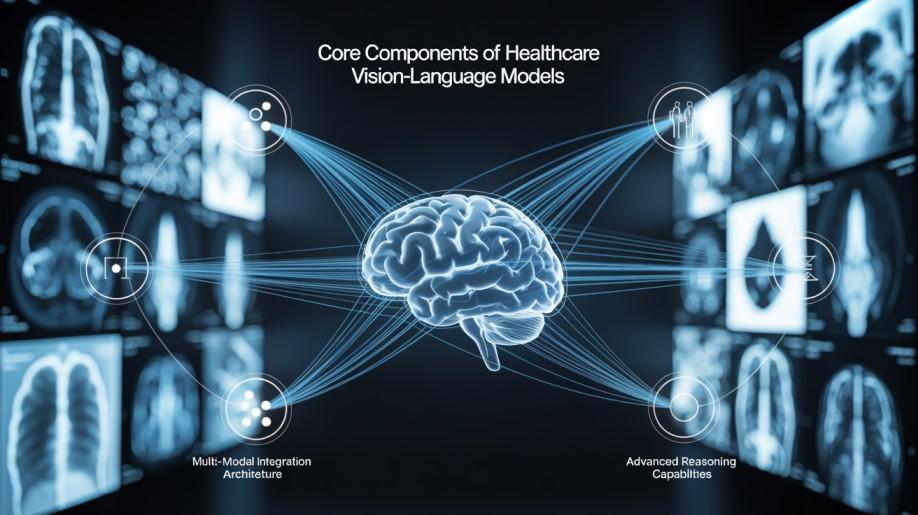
1. Multi-Modal Integration Architecture
The healthcare vision-language models and AI systems operate by seamlessly integrating visual and textual information through sophisticated multi-modal architectures.
Among them, the VLM AI systems employ the transformer-based architectures to enable effective learning from diverse medical data sources. Consequently, AI integrated VLMs can learn from radiological images, pathology slides, clinical notes, and patient histories.
The integration process of AI and VLMs is further inclusive of the following stages:
- Vision Pre-training: Initial training happens on a large corpora of medical images to establish fundamental visual representations and baseline medical imaging understanding.
- Vision-Language Pre-training: Combining visual inputs with corresponding textual descriptions are established to enhance the model's ability to correlate visual features with clinical language.
- Instruction Fine-Tuning: Optimizing performance using healthcare-specific datasets helps to improve concurrent medical task(s) execution.
- Specialized Medical Integration: Incorporating domain expert model knowledge with regular updates (with n8n) enhances long-term precision in clinical applications.
2. Advanced Reasoning Capabilities
Modern medical image reasoning AI systems make sophisticated reasoning capabilities accessible that mirror long-trusted clinical decision-making processes.
Through application of chain-of-reasoning strategies involving systematic information analysis, the vision or image learning models with AI can also handle differential diagnosis formulation, and confidence assessment.
A glimpse of the reasoning process is stated below:
- Information Synthesis: Analyzing patient symptoms, medical history, and imaging findings
- Hypothesis Generation: Developing multiple potential diagnoses based on available evidence or connected sources
- Evidence Evaluation: Weighing, supporting, and contradicting factors and evidences for each hypothesis
- Confidence Assessment: Determining certainty levels and identifying areas requiring additional investigation
What's more?
The VLMs as AI systems outperform larger multi-capable General AI models trained on over a million samples!
Clinical Applications of VLMs and Decision Support Integration
VLMs are no longer concept-based AI systems adopted carefully for certain particular applications, no. The clinical applications of vision-language models with AI decision-making are bringing the true automation that suggests the right decisions, helping shape better care delivery experiences.
1. Better Diagnostic Accuracy
VLMs and AI-based clinical decision support systems can identify diagnostic patterns that human clinicians might overlook, especially in complex cases involving multiple organ systems or rare conditions.
In emergency and intensive care settings, VLMs have shown particular promise. The NEJM Image Challenge dataset research revealed open-source models achieved diagnostic accuracy up to 40.4%.
On the other hand, advanced proprietary models like GPT-4o were noted to achieve 68.1% accuracy, supporting critical care decision-making.
P.S. It's particularly a pretty great feat, considering we already are running GPT-5!
2. Clinical Reasoning Support in Real-Time
The modern agentic reasoning AI doctors and connected systems already use cutting edge clinical decision support technology. Configuring them to go beyond simple diagnostic suggestions, they can provide comprehensive care planning that includes:
- Dynamic Treatment Planning: Continuously adapting and developing recommendations based on new and evaluated clinical information
- Multi-Step Clinical Reasoning: Following logical diagnostic pathways similar to experienced clinicians
- Patient-Specific Recommendations: Tailoring suggestions based on individual patient characteristics, medical history, and treatment outcomes
Clinical implementation studies note that these systems can reduce diagnostic delays, improve intervention outcomes, and enhance overall care quality while maintaining high safety standards.
3. Specialized Medical Applications
Medical image reasoning AI or VLMs have found particularly strong applications in specialized medical fields:
- Radiology: Advanced VLMs can analyze complex radiological images, providing detailed reports and identify subtle abnormalities that might escape initial human review.
- Pathology: AI systems can classify histopathological images with accuracy rates exceeding 93%, supporting pathologists in cancer diagnosis & treatment planning.
- Emergency Medicine: Real-time diagnostic support helps emergency physicians make rapid, accurate decisions under time pressure or in time-sensitive scenarios.
- Cardiology: AI systems assist in interpreting electrocardiograms and cardiac imaging, supporting development of newer techniques of early detection of cardiovascular conditions.
Addressing Clinical Challenges and Limitations
While we have by far learned that VLMs possess exceptional capabilities in clinical reasoning and decision making, overlooking any challenges & limitations inherited from AI is plainly unacceptable.
To address them, certain arrangements and solutions can be applied, which can reinforce industry-wide trust in everyday uses of VLMs.
1. Explainability and Trust in Medical AI
Explainable AI in medicine and healthcare remains a critical concern for real-time clinical adoption. For perspective, healthcare professionals must demonstrate transparent understanding of AI decision-making processes to maintain patient safety and clinical accountability.
Similarly, recent developments in medical VLMs have focused on providing explicit reasoning explanations. In turn, they've helped systems like MedVLM-R1 generate and improve natural language reasoning to enhance transparency and trustworthiness.
This arrangement highlights challenges that appear mainly when balancing model complexity with interpretability. However, while sophisticated reasoning capabilities improve diagnostic accuracy, they can create "black box" scenarios where the decision-making process becomes opaque to clinicians.
Conclusively, for addressing this challenge, continued development of interpretable AI components integrated into large language models are a necessity.
2. Data Quality and Bias Mitigation
Medical AI systems face significant challenges related to data quality and algorithmic bias. The known and identified common reasons for dissatisfaction with AI image generation in medical contexts include:
- Demographic Imbalances: Some training datasets underrepresent certain population groups, possibly causing disparate performance across different patient demographics
- Institutional Bias: Models trained on data from limited geographic locations or institutions may not support generalization effectively across different clinical settings
- Reference Standard Variations: Different diagnostic standards and annotation practices can introduce systematic errors in model training, learning, reasoning and decision-making.
Addressing these challenges requires taking up comprehensive approaches to dataset curation. Working examples of those approaches include diverse representation, standardized annotation protocols, and robust validation across multiple clinical environments.
3. Integration with Clinical Workflows
Successful implementation of AI in clinical decision support requires careful integration with existing healthcare workflows, including for advanced vision-language models powered by AI.Successful implementation of AI in clinical decision support requires careful integration with existing healthcare workflows, including for advanced vision-language models powered by AI. For healthcare organizations looking to build such solutions, it becomes crucial to hire AI agent developers who can design systems that align with clinical realities.
Studies imply that the effectiveness of AI systems depends heavily on:
- User Interface Design: Developing intuitive interfaces that seamlessly integrate with electronic health record systems
- Training and Education: Applying comprehensive clinician education on AI system capabilities and limitations
- Workflow Optimization: Designing AI integration that enhances established clinical processes than disrupting it
While AI systems can match or exceed human diagnostic performance in controlled settings, real-world implementation would still require ongoing human oversight and validation.
Future Directions and Emerging Technologies
As a collective, humanity is now learning to interact with VLMs, and have them perform various clinical workflow tasks, but here's what's next and ahead.
1. Advanced Reasoning Architectures
To arrive at the future of reasoning AI in healthcare, increasingly sophisticated architectures are essential to combine multiple AI approaches.
Emerging systems can also witness integrations like:
- Multi-Agent Collaboration: Custom-built VLM+Agenti AI systems where multiple AI agents work together to solve complex diagnostic challenges
- Causal Reasoning: VLM-AI systems that understand causal relationships between symptoms, conditions, and treatments, and are capable of interpreting them from visual data.
- Temporal Reasoning: VLM-AI models that can track disease progression and treatment responses over time, and suggest next care pathways based on intelligent autonomous learning.
Development of these advancements in VLM architectures promise to deliver more comprehensive and reliable clinical decision support. Potentially, the results can easily approach or also exceed specialist-level diagnostic capabilities perhaps across multiple medical domains.
2. Personalized Medicine Integration
The future medical VLMs will increasingly incorporate personalized medicine approaches, utilizing:
- Genomic Data Integration: Combining genetic information with imaging and clinical data for developing precision diagnosis.
- Individual Risk Profiling: Performing patient-specific risk assessments based on comprehensive multimodal analysis can improve personalized medicine treatment success.
- Treatment Response Prediction: Forecasting individual patient responses to specific treatments based on historical data & current presentation helps mitigate or identify underlying challenges quicker.
Note: Genomic data integration can support boosting reasoning & decision-making speed of VLMs, making it a game changer for healthcare organizations acquiring it.
3. Federated Learning and Privacy Protection
As medical AI systems become more sophisticated, adopting federated learning approaches will enable training on diverse datasets while maintaining patient privacy.
This approach can allow institutions to collaborate in model development without sharing sensitive patient information, potentially leading to developing more robust and generalizable VLMs.
Regulatory Considerations and Clinical Implementation of VLMs
The deployment of advanced medical VLMs requires careful attention to regulatory compliance and clinical validation.
For its successful implementation, healthcare organizations must navigate complex approval processes while ensuring that AI systems meet rigorous safety and efficacy standards.
The key regulatory considerations undeniably include:
- FDA Approval Pathways: Understanding of appropriate regulatory pathways and their adherence for different types of medical AI applications.
- Clinical Validation Requirements: Conducting comprehensive clinical trials to demonstrate safety and efficacy.
- Post-Market Surveillance: Implementing systems to monitor AI performance in real-world clinical settings.
- Liability and Accountability: Establishing clear frameworks for taking and sharing responsibility when AI systems are involved in clinical decision-making.
Economic Impact of VLMs in Healthcare Accessibility
Medical vision-language models have the potential to globally impact healthcare economics, in ways that return greater gains than total investment & upkeep costs, and additional benefits.
- Reducing Diagnostic Costs: Automating routine diagnostic tasks and reducing the need for multiple specialist consultations
- Improving Resource Utilization: Optimizing workflow efficiency and reducing healthcare waste
- Improving Access to Care: Providing advanced diagnostic capabilities in resource-limited settings through telemedicine platforms support borderless care delivery.
- Reducing Medical Errors: VLMs can minimise costly diagnostic errors and associated liability, preventing negative outcomes at large, regularly.
The Takeaway: The Promise of Intelligent Medical Reasoning
Clinical AI reasoning in medical vision-language models demonstrate the potential to enhance diagnostic accuracy, improve clinical decision-making, and deliver better patient outcomes across diverse medical specialties.
However, they are not attainable without the integration of healthcare vision-language AI into clinical practice requiring careful attention to explainability, bias mitigation, and workflow integration. Even so, it does eliminate the future possibility of having AI-augmented healthcare.
As these technologies continue to evolve, the focus must be on developing systems that complement human clinical expertise. Yes, the replacement of human clinical expertise is unrealistic, at least until quantum computing hits mainstream adoption.
The most successful implementations will likely involve collaborative approaches where AI systems serve as sophisticated diagnostic partners, enhancing human capability while maintaining the essential human elements of empathy, judgment, and patient care.
Want to build a VLM or develop a pilot-MVP of VLMs with clinical reasoning and GenAI combined decision-making?
A fully realized clinical AI reasoning system may be farfetched, but VLMs have laid a strong groundwork. Regardless of the pace, VLMs are actively shaping the future of healthcare delivery in every passing hour and for every dollar spent.
FAQs
Q. What are Medical Vision-Language Models (VLMs) and how do they support clinical reasoning?
Medical Vision-Language Models (VLMs) are AI systems that combine advanced computer vision and natural language processing to analyze both medical images and textual data synchronously. They enhance clinical reasoning by integrating visual findings with patient records and medical literature, aiding healthcare professionals in diagnosing, reporting, and making complex decisions more accurately and efficiently.
Q. How do VLMs improve diagnostic accuracy and efficiency for clinicians?
VLMs assist clinicians by automating the extraction and synthesis of critical information from multiple data modalities, streamlining workflows such as medical image interpretation, report generation, and visual question answering. They support quick and thorough disease assessments, which can lead to earlier and more precise diagnoses, reductions in oversight, and improved care outcomes.
Q. What are patients and clinicians' opinions about the reliability of AI-driven reasoning in VLMs?
On social platforms, common discussions revolve around trustworthiness, transparency, and explainability of AI-generated clinical decisions.
Users particularly highlight:
- The importance of understanding how VLMs arrive at specific diagnoses (chain-of-reason)
- Need for clear explanations
- Concerns about possible errors or biases after system deployments in real-world clinical settings.
Q. What are the key challenges or limitations discussed regarding adopting VLMs in healthcare?
Core challenges include limited access to high-quality, diverse training data, ongoing concerns over data privacy, and the lack of standardized evaluation metrics for clinical performance.
Additionally, effective integration into clinical workflows and ensuring model adaptability across diverse patient populations remain significant hurdles.