How to Hire Agentic AI Developers in the USA?
Milind Barot
8-10 mins
Agentic AI is transforming how businesses operate. It can help businesses by deploying AI agents, which will assist companies in improving efficiencies, reducing costs, and scaling faster. But the success of any agentic AI-powered project depends on both the technology and the human side of developing it. That's why so many teams are racing to hire agentic AI developers before their competitors do!
A bad hire can mean delays, cost overruns, security risks and an agent who never delivers the results you expect.
So the real question isn’t whether to invest in agentic AI. It is how to find, evaluate and hire the developers who can turn your idea into a working product.
The problem is that not all AI developers have the knowledge to create autonomous agents. Agentic AI needs to have capabilities in reasoning, planning, memory management, integrations, safety and real-world deployment.
So this is why choosing the right talent is one of the most important decisions you will make.
If you are thinking of building an agentic system and want to know what you are getting into before you spend a single dollar, this guide tells you all.
In this guide, you will learn:
- What agentic AI developers actually do
- How they differ from traditional AI engineers
- Why US businesses are hiring them right now
- Core skills and qualities to look for
- Hiring models, cost, and the full hiring process
- Red flags, compliance rules, and KPIs that prove value
By the end of this guide, you'll have a clear understanding of how to hire agentic AI developers in the USA, what to pay, what pitfalls to avoid, and how to transition from uncertainty to a confident hiring decision that yields tangible results.
What Are Agentic AI Developers?
Agentic AI developers are speciality engineers who design autonomous software agents capable of reasoning, planning and acting on their own to complete multi-step tasks.
They do not simply train a model and leave it at that point. They craft digital employees that see the environment, decide what they need to do, perform tasks within your environment autonomously, and learn based on the results of their actions.
This whole process is known as a perception-reasoning-action cycle, during which the agent takes in an input, contextualizes it, makes decisions about the way forward, and acts accordingly without requiring human supervision every step of the way. It's the loop that defines the concept of an autonomous agent.
Developers of such agents design the whole technology stack. They integrate LLMs, memory components, automation software, and reasoning frameworks to craft agents that operate similarly to team members.
Their mission is to ensure that an agent is robust, safe, and accurate in dealing with any situations that have not been pre-programmed.
When you hire agentic AI developers, you hire experts in building autonomous thinkers and executors, not just dashboard responders.
Agentic AI Developer vs Traditional AI Engineer: At a Glance
Here is a quick comparison so you know exactly who you need:
| Factor | Traditional AI Engineer | Agentic AI Developer |
|---|---|---|
| Core focus | Builds and trains models for predictions | Builds autonomous agents that plan and act |
| Behavior | Responds to a single input | Handles multi-step workflows end-to-end |
| Decision-making | Returns an output for review | Decides and executes with minimal input |
| Key strength | Accuracy in analytics and forecasting | Reasoning, orchestration, and tool use |
| Best for | Data insights and classification | Scalable automation and digital workers |
In short,
- A classical engineer excels in scenarios where analytics, scores, and forecasts come into play.
- An agentic AI developer comes into play in situations where you seek something that acts throughout your business systems and gets better through time.
Being aware of the difference ensures that you don’t end up with the wrong set of skills.
Why Are Businesses Hiring USA Agentic AI Developers Now?
The transition to the agentic artificial intelligence is occurring rapidly, and here is why.
As MarketsandMarkets states, the global market for agentic AI will increase from USD 7.06 billion to USD 93.20 billion by 2032 at an average rate of 44.6%.
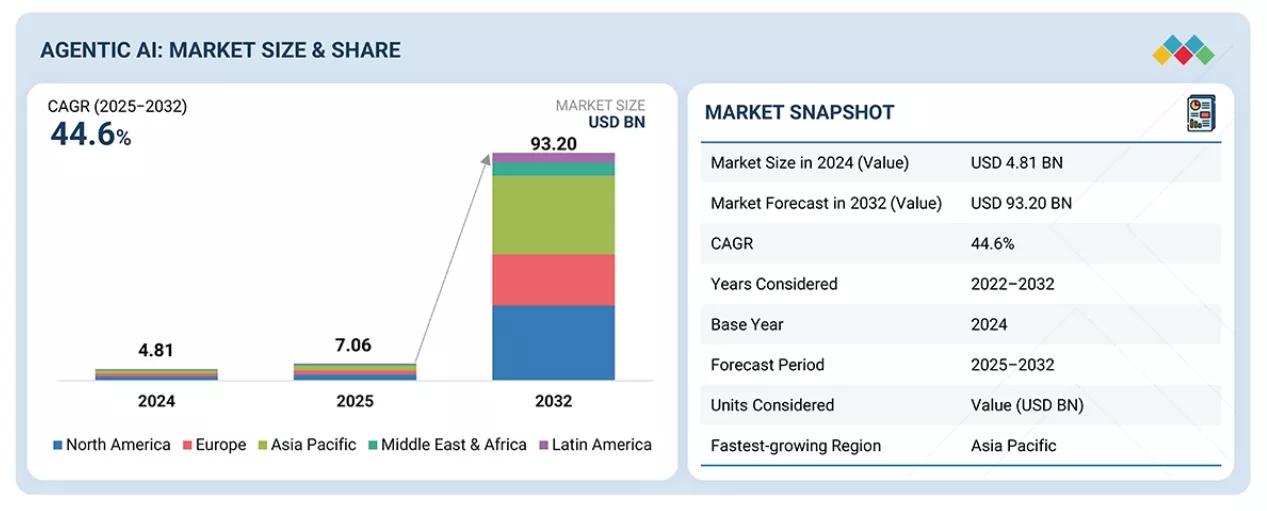
Such growth proves the direction into which investments are currently being made.
Apart from statistics, there are practical reasons why businesses are employing agentic AI developers as the benefits appear on many fronts of their operations:
- Improved customer support: AI bots will be able to handle the most frequent customer queries, solve their problems instantly, and help the customer support staff concentrate on solving more intricate issues.
- Automation of routine tasks: Tasks such as filling out forms, making schedules, creating reports, and contacting clients can be done by AI bots and hence save time.
- Fast data analysis and decision-making: In a very short while, AI bots can analyze huge volumes of data and help businesses make better-informed decisions.
- Scalability: With an increased workload, more tasks will be handled by AI bots without having to hire extra workers.
Common Agentic AI Use Cases Businesses Hire Developers For
- AI Customer Support Agents
- AI Sales Qualification Agents
- AI Appointment Booking Agents
- AI Research & Knowledge Agents
- AI Document Processing Agents
- AI Workflow Automation Agents
Case Study: AI-Powered Interview Platform for Hiring
7 Core Skills to Look For in an Agentic AI Developer
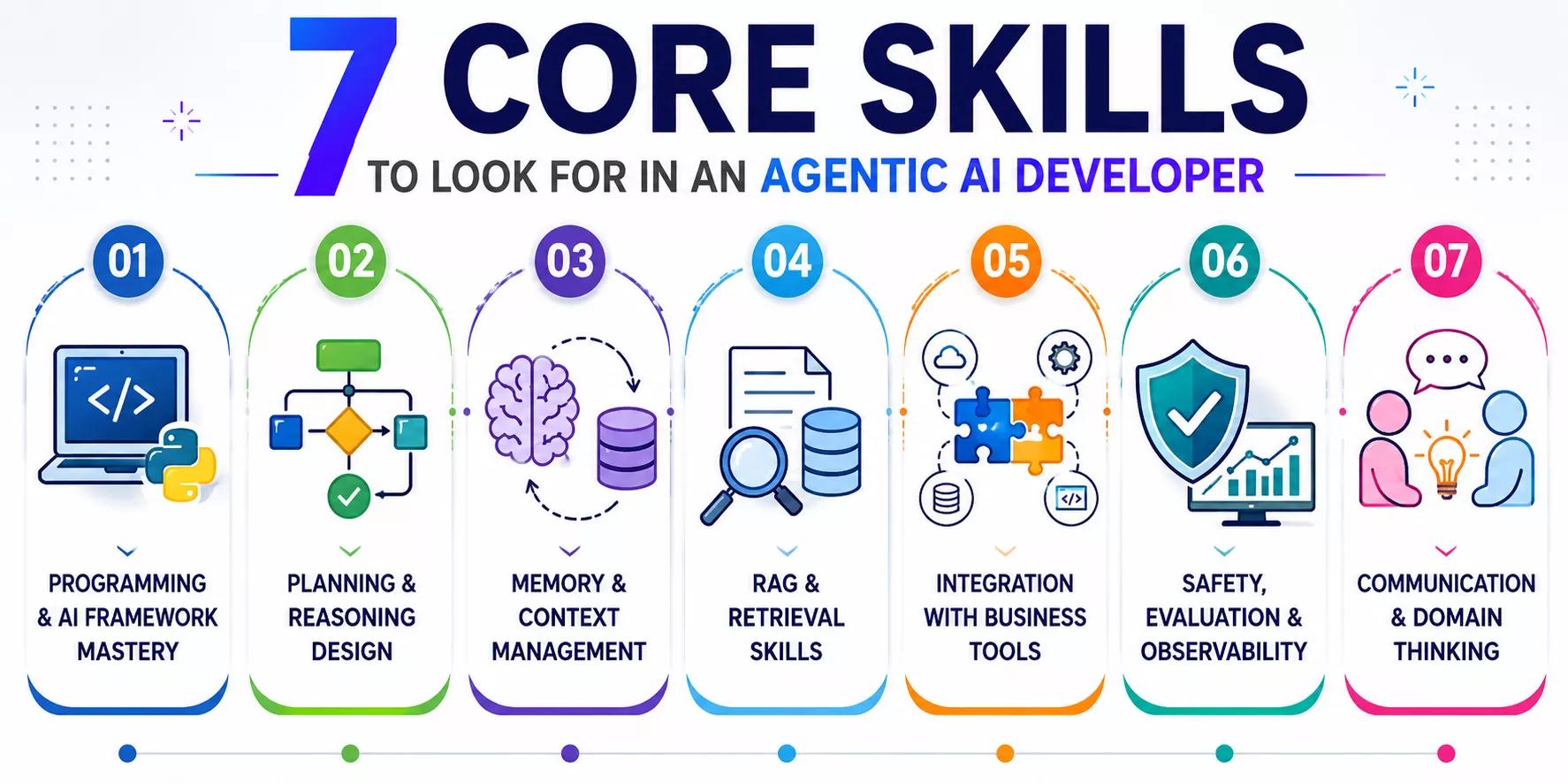
Hiring the right person starts with knowing which skills actually matter. Here are the core skills that show up across every reliable hire:
1. Programming and AI Framework Mastery
Strong agentic developers are fluent in Python first, with Java or C++ as useful extras for specific builds. Beyond raw coding, they know agentic frameworks like LangChain, LangGraph, AutoGen, and CrewAI inside out. This fluency lets them assemble reasoning loops and multi-agent systems quickly instead of reinventing the basics every time.
2. Planning and Reasoning Design
This is where all of the work of agents happens. An able developer can design agents that plan their actions, select appropriate instruments, and correct themselves if any step doesn’t work. What you need is an engineer who approaches his job via workflows and edge cases rather than someone who simply prompts an agent and hopes it will hit the mark.
3. Memory and Context Management
Good agents remember. Your developer should know how to build memory layers so the agent recalls past actions and decisions, then uses that context to make better choices later. Without a solid memory design, agents repeat mistakes and lose the thread on anything that spans multiple steps.
4. RAG and Retrieval Skills
Most production agents need to pull accurate information from your own data. Look for hands-on experience with retrieval-augmented generation and vector databases like Pinecone, Weaviate, etc. This skill keeps the agent's answers grounded in your real documents instead of guessing and hallucinating.
5. Integration With Business Tools
An agent that cannot connect to your systems remains a demo. Your developer must integrate agents with CRMs, ERPs, APIs, and databases so they actually run real workflows. Strong integration skills turn a clever prototype into a tool your team uses every single day.
6. Safety, Evaluation, and Observability
Autonomy without checks and balances can get you in trouble. The best engineers develop evaluation frameworks in advance, add necessary safety checks, and provide observability of the agent’s work. This skill is the one that differentiates between those who produce impressive demos and engineers capable of building reliable systems.
7. Communication and Domain Thinking
Technical skill alone is not enough. A great agentic developer explains why an agent made a decision in plain language and applies domain knowledge to your industry. This blend of clarity and context makes adoption smooth and keeps your business team confident in the system.
Also Read: Why Hire AI Agent Developers? Process, Skills, and Cost
Hiring Models: In-House vs Freelancers vs Development Partner
Once you know what you need built, the next decision is how to staff it. Each model carries real trade-offs in cost, speed, and control. Understanding them helps you pick the path that fits your stage and budget.
Here is a quick side-by-side to make the choice clearer:
| Factor | In-House | Freelancers | Development Partner |
|---|---|---|---|
| Time to first agent | 4 to 9 months | 2 to 4 weeks | 3 to 6 weeks |
| Upfront cost | High salaries and infrastructure | Variable | Fixed, predictable scope |
| Expertise on day one | Needs recruiting | Limited to one person | Full team available |
| Maintenance | Fully on your team | Inconsistent | Shared or included |
| Best for | Long-term AI capability | Small tasks | Fast, proven ROI |
Which Model Should You Choose?
- Choose In-House if AI is a core strategic capability.
- Choose an Agency if you want faster deployment and lower execution risk.
- Choose Offshore Teams if budget is the primary concern.
Let’s understand in detail!
1. Building an In-House Team
Having full-time agentic developers on board will ensure the highest degree of goal correlation and complete control of your data and roadmap. On the other hand, hiring comes at a price, especially if we consider such factors as recruiting costs, salaries, infrastructure, and other expenses associated with setting things up. Such an approach is best for companies with long-term plans to develop their own in-house capabilities.
2. Working With Freelancers
This approach offers you greater flexibility and a relatively low entry point, making it perfect for a trial run or small project. However, collaboration with a freelance developer will be less efficient due to their limited skills scope and inability to provide a complete stack including architecture, integration, etc. Therefore, freelance developers are best used as assistants.
3. Partnering With a Development Company
Here, you get experienced professionals, fast development, and all the necessary skills and expertise right out of the box. Hiring becomes less of a problem, while architecture, integration, testing and other aspects are combined in one package. This approach is best for the majority of SMBs trying to create their own first build.
Step-by-Step Process to Hire Agentic AI Developers
Hiring an agentic developer is a process, not a gamble. Follow these steps carefully, and you reduce risk, save time, and make a confident decision:

Step 1: Define Your Agent Requirements
Start by writing down exactly what you want the agent to do. List the workflows you want to automate, the data sources it will use, the systems it must connect to, and the outcome you expect. The clearer you are here, the easier everything that follows becomes. If you cannot describe the problem in a sentence or two, pause and sharpen it before you talk to anyone.
Step 2: Shortlist Potential Developers or Partners
Now, research and build a list of eight to ten candidates or companies that match your needs. Look at their portfolios, case studies, reviews, and the kind of agents they have actually shipped. Then narrow that list down to three to five serious options. This focused shortlist keeps your time on capable partners instead of long, scattered conversations.
Step 3: Send a Detailed Brief or RFP
Share a clear brief that includes your goals, requirements, budget range, and expected timeline. A strong candidate replies with a specific, tailored response that shows they understood your problem. If the reply feels generic or copy-pasted, treat that as an early warning that they may not be paying close attention.
Step 4: Run a Practical Technical Evaluation
Test how they think, not just what they claim. Give a small design challenge, such as sketching an agent workflow for order fulfillment, and watch how they break down tasks, pick tools, and plan fail-safes. Keep it to under an hour. You are looking for clear reasoning about agent design, error handling, and scalability, not perfect production code.
Step 5: Interview for Depth and Communication
Ask open-ended questions that reveal real experience. Questions like how they handled emergent behavior in a past project, or how they balance performance with safety, expose true depth. Pay attention to whether they explain complex ideas in plain language, because clear communication predicts smooth collaboration with your business team.
Step 6: Review the Contract Carefully
Before you commit, read every term with attention. Check the scope of work, timeline, cost structure, data ownership, and IP rights, and make sure there are no hidden clauses. A fair, transparent contract protects both sides and sets the tone for a healthy working relationship. Never rush this step just to start faster.
Step 7: Onboard and Kick Off the Project
Once you choose your developer, set them up to succeed. Provide access, datasets, documentation, and sprint plans, then bring them into your communication channels like Slack or Jira. Clear onboarding reduces rework and gets your agent moving from planning to building without unnecessary delays. A smooth start almost always leads to a smoother delivery.
Also Read: How Multi-Agent AI Systems Are Transforming Enterprise Automation
Interview Questions to Ask Before Hiring Agentic AI Developers
Technical Questions
- Which agent frameworks have you used in production?
- How do you handle memory and context retention?
- Have you built multi-agent systems?
- How do you evaluate agent performance?
Architecture Questions
- How would you design an AI agent for customer support?
- How do you prevent hallucinations?
- How do you secure enterprise data?
Business Questions
- Can you share a production deployment?
- What ROI did the client achieve?
- What challenges did you encounter?
Red Flags to Avoid When Hiring Agentic AI Developers
Even with a structured hiring process, choosing the wrong developer can lead to delays, extra costs, and poor results. Watch for these common red flags before making a decision:
- Absence of agent-building AI experience: While they talk about machine learning or artificial intelligence in general terms, they do not have much experience in developing autonomous agents, multi-agent systems, or any agentic AI system.
- Agent as a mere chatbot: While they focus solely on conversations and prompts, they do not understand agents' capability to reason, plan, remember things, use tools, or automate workflows.
- No practical project experience: All their work includes demonstrations, which they have never applied in real-world settings to produce some tangible results.
- Not familiar with frameworks: Since they do not develop agents in real life, they probably have zero experience working with agent development frameworks like LangChain, LangGraph, AutoGen, or CrewAI.
- Security, compliance ignorance: They cannot tell anything about data protection, security, auditing trail creation, or compliance with regulations like HIPAA or GDPR.
- Communication incompetence: Unable to explain complex ideas clearly, they cannot tie them to business requirements.
Now that you know what to avoid, let us turn to the numbers and break down what hiring agentic AI developers in the USA actually costs.
Cost to Hire Agentic AI Developers in the USA
Cost is usually the deciding factor, and the honest answer is that it goes well beyond salary. When you hire agentic AI developers in the USA, you are funding an entire ecosystem of talent, infrastructure, compliance, and ongoing care. Here is a realistic picture so you can plan with confidence.
The table below shows ranges based on how you choose to hire:
| Engagement Type | Typical Cost | Best For |
|---|---|---|
| Freelancers | $50 to 150 per hour | Small tasks and quick experiments |
| Full-time US developer | $140K to 210K per year | Long-term in-house capability |
| Small agency project | $10K to 50K | Focused, single-agent builds |
| Enterprise system | $100K and above | Multi-agent, production-scale builds |
| Monthly maintenance | $500 to 3K | Ongoing monitoring and tuning |
Several factors can affect the overall cost of hiring agentic AI developers, including:
- Complexity of project: Simple AI-based programs are cheaper than sophisticated multi-agent AI programs.
- Experience of programmers involved: Experienced programmers usually have higher rates than beginners.
- Number of connections with business software systems: It takes more time to develop programs that connect to CRM, ERP, API, DB, and other types of software.
- Quality of data provided by client: The lack of structured data can lead to the need for extra work.
- Regulatory compliance: Some industries such as healthcare and financial require more security and tests.
Also Read: AI Automation Consulting: Cost, Benefits, and How to Choose the Right Partner
How Long Does It Take to Hire Agentic AI Developers?
| Hiring Method | Time |
|---|---|
| Freelancer | 1-2 Weeks |
| In-House | 2-6 Months |
| Agency | 1-3 Weeks |
Security & Compliance Checklist Before Hiring Agentic AI Developers
Compliance is an essential aspect when developing any kind of agentic artificial intelligence. The developer needs to have knowledge of applicable security and compliance requirements within their specific industry.
1. Data Privacy (GDPR and CCPA)
Your agent will need to be compliant with data privacy regulations such as GDPR and CCPA if it uses personal data from customers or employees. You should select developers who are experienced with privacy systems.
2. Healthcare Compliance (HIPAA)
Any developer who will develop an AI agent for use in health care needs to be HIPAA compliant. They should know how to securely process the personal health information of patients.
3. Financial Regulations
FinTech AI systems require the ability to securely process transactions, detect fraud, and audit financial operations. Compliance knowledge will come in handy when designing and developing such an agent.
4. AI Governance Standards
The AI Risk Management Framework by NIST is one framework that will guide developers on how to design AI agents that are unbiased and transparent.
5. Security and Cloud Compliance
SOC 2 and ISO 27001 standards can help you keep your customer and business data safe.
How to Evaluate Success After Hiring an Agentic AI Developer
To measure the success of your agentic AI project, track these key performance indicators (KPIs):
- Task Success Rate: Measures how many tasks the agent completes successfully. A strong system typically improves from 60-70% during testing to 90%+ in production.
- Autonomy Level: Tracks how often the agent completes tasks without human involvement. Many projects improve from 40% autonomy to 75% or higher over time.
- Cost Savings: Measures reductions in operational costs. For example, an AI agent that lowers support costs by 30% delivers clear business value.
- Speed and Efficiency: Evaluates how much faster tasks are completed. Reducing a process from 10 minutes to 5 minutes results in a 50% efficiency improvement.
- Customer Satisfaction and Compliance: Monitor customer satisfaction through CSAT or NPS scores while maintaining zero compliance violations and keeping error rates below 2%.
Tracking these KPIs helps you measure ROI, identify improvement opportunities, and ensure your AI agents continue delivering business value.
Why Do Businesses Trust Ciphernutz to Build Agentic AI?
You can plan your hire, set your budget, and map your KPIs. Yet the execution is what decides whether any of it works.
That is exactly where Ciphernutz makes the difference for businesses across the US, UK, and the Middle East.
We build agents that run real operations, not demos that stall after a flashy presentation. Our team designs autonomous systems that reason, decide, and execute across your tools, with compliance and scalability built in from the start.
What makes us stand out?
- Delivering AI-powered products for 60+ clients with a 98% client retention rate
- Fixed-scope, production-ready delivery in 3 to 6 weeks, never open-ended timelines
- Zero templates, every system custom-built around your actual stack and operations
- Compliance-ready engineering with HIPAA-aware, secure, and self-hosted options for regulated industries
- End-to-end expertise from strategy and architecture through deployment, monitoring, and support
- Risk-free engagement with a one-week trial, flexible models, a strict NDA, and a dedicated project manager
Need to Hire Agentic AI Developers?
Whether you're building an AI customer support agent, AI sales assistant, AI workflow automation system, or a multi-agent enterprise platform, our team can help you move from concept to production in weeks, not months.
Conclusion
Agentic AI is quickly becoming a core advantage for businesses that want to move faster, cut manual work, and scale without piling on headcount.
The technology is ready, the market is growing, and the opportunity is real. Yet the difference between a system that ships and one that stalls almost always comes down to the development partner you hire.
The right developer understands reasoning, memory, integration, compliance, and scalability. They show real proof, communicate clearly, and build for what comes next.
When you hire agentic AI developers with that depth, you protect your timeline, your budget, and your path to results.
We hope this guide helped you understand how to hire agentic AI developers in the USA, what to look for, what to pay, and how to avoid the mistakes that derail most projects.
Now it is your turn. Look at your goals, define one clear use case, and choose a partner who can turn that idea into a working product. When you are ready, connect with our experts to plan your build and move forward with clarity.
FAQs
How long does it take to build an agentic AI project?
Timelines depend on complexity. A basic proof of concept often takes 6 to 8 weeks, while a full production system can take 4 to 6 months. Working with an experienced US-focused team usually shortens this, since they already understand compliance, integration, and industry-specific requirements.
Should I hire agentic AI developers in-house or work with a partner?
In-house hiring fits companies planning long-term AI research and capability, but it brings high costs and a longer ramp-up. A specialized partner lets you start faster, reduce overhead, and tap proven expertise. Many businesses use a hybrid model, with one internal hire supported by an external team.
How much does it cost to hire agentic AI developers in the USA?
Cost varies by model and complexity. Freelancers run USD 50 to 150 per hour, full-time US developers range from USD 140K to 210K per year, and agency projects span from USD 10K to well over USD 100K. Hidden costs like infrastructure and compliance also factor in.
What is the difference between US-based and offshore agentic AI developers?
US-based developers work within the same legal and compliance frameworks as your business and align easily with time zones. Offshore teams can lower costs while still delivering strong quality, especially when they understand US compliance like HIPAA and GDPR. Many companies blend both for balance.
Do agentic AI developers handle integration with existing systems?
Yes, integration is one of their core strengths. Skilled developers connect agents with CRMs, ERPs, cloud platforms, and APIs so the agents run inside your real workflows. This ensures your agents become embedded operational tools rather than standalone experiments that never reach daily use.
What skills should I verify before hiring an agentic AI developer?
Confirm fluency in Python and agentic frameworks like LangChain or AutoGen, plus experience in planning, memory design, RAG, and integration. Also, check for safety, evaluation discipline, and clear communication. Real, deployed project examples matter far more than theoretical knowledge alone.
How can I start with a small agentic AI project to reduce risk?
Begin with one focused use case and a proof of concept rather than a full build. This validates feasibility, proves ROI, and keeps your initial spend low. Once you see real results, you can scale confidently based on actual performance instead of assumptions.