How to Integrate Triage AI with EHR Systems Using n8n
Vijay Vamja
4-5 mins
The healthcare industry is evolving at lightning speed. Patients expect faster service, doctors need accurate insights, and hospitals are under pressure to optimize operations without exhausting their staff.
The biggest challenge? Patient triage and data management.
When a patient arrives at the hospital, the first step, triage, decides how urgent their condition is and how quickly they should receive care. Traditionally, this is done manually, often leading to errors, delays, and overcrowding in emergency departments.
Now imagine if an AI-powered triage agent could instantly analyze symptoms, access patient history, and prioritize cases accurately all while automatically updating your hospital’s Electronic Health Record (EHR) system. That’s exactly what you get when you integrate Triage AI with EHR systems using n8n workflows.
In this blog, we’ll explore how the integration works, why it matters for hospitals, and how you can implement it to reduce patient wait times, cut costs, and improve care quality.
What is a Triage AI Agent System?
A Triage AI Agent System is a digital solution that uses artificial intelligence to evaluate patient data, symptoms, and medical history. It assigns a priority score and helps doctors and nurses decide who needs immediate attention and who can safely wait.
Key capabilities of a Triage AI Agent include:
- Automated Patient Intake: Collects patient symptoms through digital forms or chatbots.
- Risk Prioritization: Uses machine learning to assign urgency levels.
- Data Integration: Sends results directly to the hospital’s EHR.
- Decision Support: Provides doctors with actionable insights before the patient is seen.
When powered by automation tools like n8n, these agents become even more powerful because n8n can seamlessly integrate the AI system with hospital databases, scheduling tools, and communication channels.
Curious about multi-layered AI models? Explore Multi-Agent Triage Systems.
Why Hospitals Need Triage AI + EHR Integration
Here’s why hospitals are rapidly adopting AI triage systems:
- Reduce Emergency Department Overcrowding: Patients with less urgent issues often clog the ER. AI helps fast-track critical patients.
- Consistency in Decision-Making: Unlike human triage staff, AI doesn’t get tired or biased.
- Faster Documentation: Integration with EHR ensures no double entry of data.
- Better Use of Staff Resources: Doctors and nurses can focus on treatment instead of paperwork.
- Improved Patient Experience: Less waiting, more confidence in hospital care.
This is where n8n healthcare automation shines. It connects AI with hospital systems so data flows automatically, reducing human workload and improving efficiency.
Why n8n is the Best Tool for AI + EHR Integration
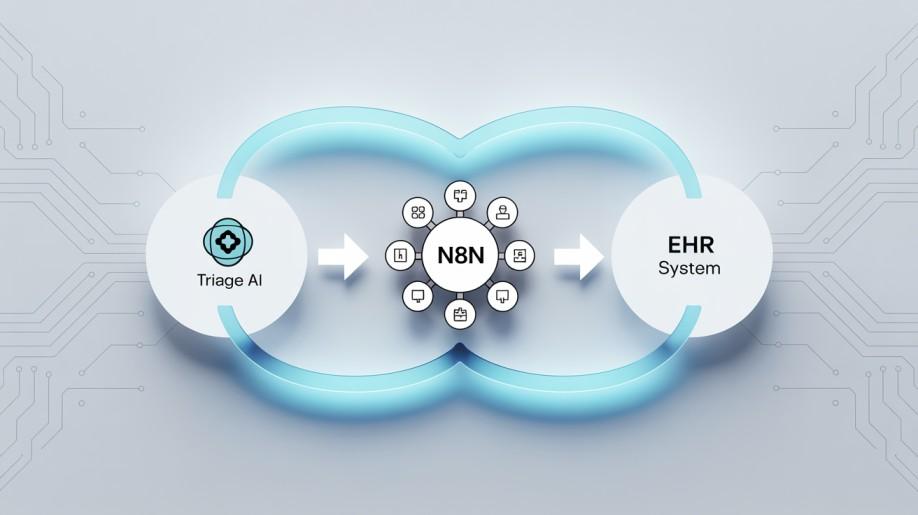
n8n is an open-source, low-code workflow automation tool that lets hospitals connect multiple systems without writing heavy code.
Here’s why it’s a perfect fit for healthcare:
- API-first approach: Connects to almost any EHR or AI service.
- Custom workflows: Tailored to your hospital’s needs (intake, lab reports, triage alerts).
- Cost-effective: Avoids the expense of custom-built middleware.
- Scalable: Works with single or multiple triage AI agents.
- Secure: HIPAA-compliant implementations are possible when designed by experts.
n8n EHR integration enables triage AI automation without disrupting your existing hospital systems.
Comparison: Manual Triage vs. Triage AI with n8n Integration
| Aspect | Manual Triage | Triage AI + n8n Integration |
|---|---|---|
| Speed | Depends on staff availability | Real-time processing of patient data |
| Accuracy | Prone to human bias/errors | Consistent, data-driven prioritization |
| EHR Updates | Manual entry, time-consuming | Automatic integration with EHR systems |
| Patient Experience | Longer wait times, frustration | Faster triage, transparent communication |
| Staff Workload | High administrative burden | Reduced workload, more focus on treatment |
| Scalability | Limited to staff numbers | Scales easily with patient volume |
Step-by-Step: How to Integrate Triage AI with EHR Using n8n
The process sounds technical, but broken down, it’s easy to follow:
1. Define Your Triage Workflows
Start by mapping out where triage automation will help most:
- Emergency room patient prioritization
- Outpatient appointment scheduling
- Lab result alerts
- Chronic patient monitoring
2. Connect n8n with EHR and AI Systems
- Use n8n nodes to connect with EHR databases (Epic, Cerner, or custom-built).
- Add a connection with your Triage AI Agent API.
- Link with external systems (SMS/email for patient communication).
3. Automate the Triage Process
- Patient submits symptoms digitally → AI evaluates urgency → n8n writes results into EHR.
- High-priority cases trigger alerts for doctors instantly.
- Patients receive appointment or waiting time updates via SMS/email.
4. Test and Optimize
- Run small-scale pilots in ER or outpatient clinics.
- Ensure compliance with HIPAA/GDPR.
- Refine workflows based on staff feedback.
Within weeks, you can see shorter patient waiting times and improved care coordination.
Get a Free Workflow Consultation
Discover how automation can streamline your hospital operations. Book a 30-minute consultation with our integration experts.
Real-World Example: Saving Lives with Triage AI
Imagine this scenario:
A 52-year-old patient arrives with chest pain. Instead of waiting in line, they input their symptoms into a digital triage system.
- Triage AI Agent evaluates the risk instantly.
- n8n workflow pushes the results into the EHR, flagging it as a “critical case.”
- Cardiologists get an immediate alert on their dashboard.
By the time the patient reaches the doctor, their medical history and risk score are already available. This saves precious minutes and potentially saves lives.
Why Partner with Healtech Experts
While tools like n8n make integration easier, healthcare IT isn’t plug-and-play. Data security, compliance, and workflow design all require expertise. That’s why hospitals partner with a custom healthcare software development company like Ciphernutz IT Services.
Our team helps hospitals:
- Design HIPAA-compliant workflows
- Build AI-driven triage systems
- Customize EHR integration
- Scale automation without disruptions
How Triage AI Supports Digital Transformation in Healthcare
The integration of AI and automation is more than just a tech upgrade, it’s part of the broader digital transformation in healthcare.
Benefits include:
- Predictive Care: AI can forecast patient risks before symptoms worsen.
- Reduced Burnout: Automation reduces staff overload.
- Better Patient Engagement: Real-time updates and transparency.
- Data-Driven Decisions: Hospitals gain insights from triage and treatment patterns.
Hospitals that adopt early will not just survive but thrive in the AI-driven healthcare.
Final Thoughts
The future of healthcare lies in smart automation. By integrating Triage AI with EHR systems using n8n, hospitals can transform how they manage patient flow, reduce costs, and improve care quality.
The question isn’t if hospitals should adopt triage AI automation; it’s how quickly they can implement it. Contact Us today and explore how our healthcare IT solutions can help your hospital move into the future.
FAQs
Q. What is the role of AI in EHR/EMR integration?
AI improves efficiency by automating data entry, analyzing patient data in real time, and reducing manual errors.
Q. Can n8n integrate with all EHR systems?
Yes. Since most EHRs offer APIs or database access, n8n can connect seamlessly with Epic, Cerner, Allscripts, or custom solutions.
Q. Is Triage AI automation HIPAA-compliant?
Yes, when implemented by a certified healthcare IT solutions partner. Compliance depends on encryption, access control, and workflow design.
Q. How does Triage AI improve patient flow?
By analyzing cases instantly, it prioritizes urgent patients, reduces waiting times, and prevents ER overcrowding.
Q. How do I get started with Triage AI in my hospital?
Begin with a pilot project. Identify a key workflow (like ER triage), integrate AI with EHR via n8n, and scale after successful testing.
Q. Why should I hire n8n experts instead of doing it in-house?
Because healthcare automation involves compliance, security, and scalability. Hiring n8n experts ensures seamless, compliant, and future-ready integration.
Q. Can Triage AI replace human triage nurses?
No. AI supports decision-making but doesn’t replace human judgment. It ensures nurses and doctors have the right information faster.