Rethinking AI in Healthcare: A Multi-Agent Model for Clinic Efficiency
Vijay Vamja
10-12 mins
AI in healthcare has transitioned from being an assistive technology to being the decision-maker, coordinator, analyst, communicator, executor, auditor, optimizer, and collaborator. Of course, all these roles are possible because of multi-AI agent deployments in clinical, operational, and administrative ecosystems.
Multi-agent AI deployments are today also empowering clinics to enhance patient satisfaction, streamline administrative tasks, and integrate disparate software ecosystems efficiently. However, the autonomous agents can only be made with the help of an AI agent development company, while they collaborate to deliver comprehensive healthcare solutions.
Let's learn how collaborative multi-agent systems (MAS) can be developed and how they address the complicated clinical issues to enhance healthcare.
Understanding Multi-Agent AI Architecture in Healthcare
A multi-agent AI system mainly consists of multiple autonomous AI agents that communicate, collaborate, and coordinate their actions to achieve complex healthcare objectives.
Each agent specialized in a specific domain (token-tuned) while maintaining its ability to share the information and trigger coordinated responses across the healthcare system.
To achieve all this, the architecture differs fundamentally from traditional AI systems. While single-agent AI systems follow predetermined workflows, multi-agent systems enable dynamic decision-making and real-time adaptability. This particular distinction is critical in healthcare, where thinking & deciding quickly and care delivery are essential at all times.
Tsinghua University's Multi-Agent Hospital
An independent research from Tsinghua University's Agent Hospital project demonstrates the potential scale of their multi-agent system. The deployment of 21 specialized AI agents across different medical specialties achieved 93% diagnostic accuracy while managing 10,000 patient cases.
In perspective, this is a scale that would require human doctors years to process. The project's transition from simulation to real-world implementation ultimately illustrates the maturation of multi-agent healthcare applications.
Therefore, let's look into how these multi-agent AI systems in healthcare can be built, followed by observing a standard five-agent deployment and its respective roles.
The Five AI Agent Clinic Ecosystem
Onboarding the following five types of AI agents in everyday healthcare workflow to operate on a multi-agent scale requires them to work in coordinated harmony.
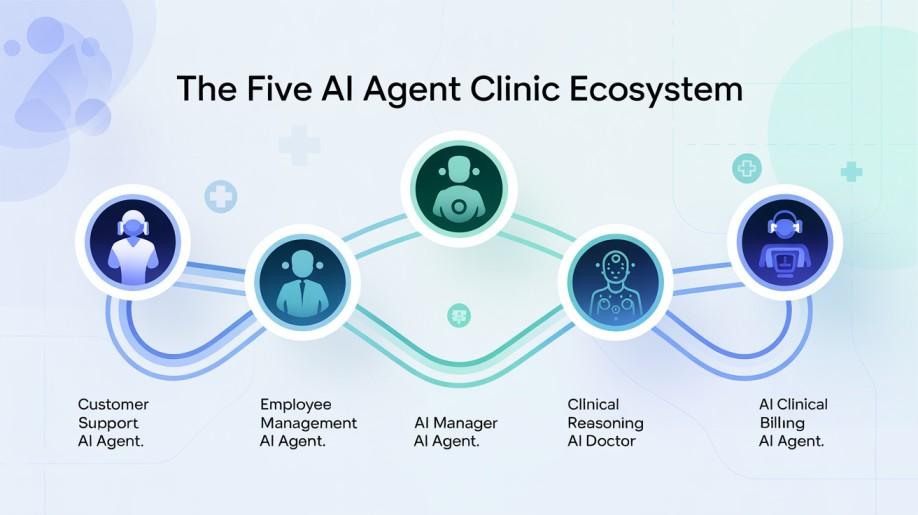
1. Customer Support AI Agent
Tasks related to appointment booking and patient communication across departments are handled by the customer support AI agent to reduce manual administrative work. They also support lowering overhead costs by actively managing about 80% of routine inquiries so healthcare teams can focus on higher-value patient care activities. This agent provides 24/7 availability for addressing patient needs outside traditional business hours and to improve overall patient satisfaction.
Case Study: AI-Powered Customer Support Automation Engine
2. Employee Management AI Agent
The responsibilities of an employee management AI agent include assigning appointments and balancing staff workloads to expedite patient onboarding and minimize operational bottlenecks. This agent analyzes patterns in patient flow, staff availability, and resource utilization to optimize scheduling decisions. At the time, their participation via automation of complex workflow coordination notably reported a 13-21% increase in staff productivity.
3. AI Manager Agent
It is a supervisory agent that monitors operations and surfaces issues, ensuring smoother daily workflows and better efficiency in staff time utilization. By integrating data from multiple sources and AI agents, the manager agent identifies patterns that might indicate emerging issues or optimization opportunities. Through the delivered real-time insights, this AI agent enables proactive problem-solving rather than reactive crisis management.
4. Clinical Reasoning AI Doctor
Although it specializes in clinical support, this agent triages symptoms to provide quick advice where appropriate and escalates complex cases to human physicians. Clinical decision support agents process vast datasets of patient history, symptoms, and medical research with reasoning capabilities to provide evidence-based recommendations. It's natural for them to demonstrate superior performance to standard clinical scoring methods, particularly in areas like sepsis prediction, where early intervention saves lives.
Read more: Agentic Reasoning AI Doctor
5. AI Clinical Billing Agent
This agent handles invoices, insurance claims, and answers payment-related questions, improving cash flow and reducing billing errors. You can expect it to automate prior authorization processes, reducing manual work by 40% and expediting patient care delivery. Moreover, healthcare organizations implementing AI-powered billing agents report denial rate reductions from 11.2% to 2.4%, significantly accelerating revenue cycle management.
Integration Layers of Multi-Agent AI Systems in Healthcare
The Integration Layer serves as the communication backbone connecting AI agents with Electronic Health Record (EHR) systems, telehealth platforms, and existing clinic software. This infrastructure eliminates the need for staff to juggle multiple tools, creating a unified operational environment.
An AI agent development company can assist you in building and deploying the following components of the integration layer:
- API Orchestration: RESTful and GraphQL APIs allow agents to fetch and push data efficiently.
- Event-Driven Architecture: Agents communicate via event buses to trigger workflows asynchronously.
- Security & Compliance: End-to-end encryption, HIPAA compliance, and role-based access control protect patient data.
- Data Normalization: Standardizes input from multiple systems, allowing agents to analyze and act consistently.
- n8n AI Integration: Workflow automation with n8n enables orchestrating complex agent tasks, such as billing approvals or appointment scheduling.
Furthermore, the distributed agents interact through a communication protocol as discussed earlier (Five AI agent ecosystem). Within this ecosystem, the integration layer and other components operate in the following capacity:
- Integration Layer: Connects EHR, telehealth, and operational tools.
- Coordination Mechanism: Ensures tasks are allocated without conflicts.
- Autonomy Module: Allows agents to operate independently with defined objectives.
In addition to the aforementioned functions, the integration layer of multi-agent AI in healthcare assists the following processes and beneficial outcomes in the healthcare ecosystem.
1. Authentication and Authorization
Role-based access controls ensure agents only access data relevant to their functions while maintaining HIPAA compliance. Each agent operates within defined permission boundaries, preventing unauthorized data access.
2. Data Transformation
Healthcare systems often use different data formats and terminologies. AI-powered mapping automatically translates between systems, reducing manual configuration requirements and ensuring data consistency.
3. Real-Time Synchronization
Agents require current information to make accurate decisions. The integration layer maintains continuous data synchronization across all connected systems, ensuring patient records reflect the most recent clinical interactions.
4. Security and Compliance Architecture
Healthcare AI implementations must address stringent regulatory requirements. The integration layer incorporates end-to-end encryption, comprehensive audit logging, and mechanisms for maintaining patient privacy while enabling agent functionality. These security measures extend beyond basic compliance to include AI-specific considerations like model governance and decision transparency.
5. Quantified Benefits and ROI Impact
Healthcare organizations implementing multi-agent AI systems report substantial operational improvements across multiple metrics:
6. Administrative Efficiency Gains
McKinsey research indicates that AI could automate up to 45% of administrative tasks in healthcare, potentially saving $150 billion annually. Multi-agent systems amplify these benefits by coordinating multiple administrative functions simultaneously. Organizations typically achieve 20-40% reductions in administrative costs, with many realizing positive ROI within the first year.
7. Clinical Workflow Optimization
Patient wait times represent a significant operational challenge, with traditional processes averaging 52 minutes in emergency departments. Multi-agent implementations demonstrate dramatic improvements, with Metro Health System reducing wait times to under 8 minutes—an 85% improvement. These efficiency gains translate directly to improved patient satisfaction and increased throughput.
8. Financial Performance Improvements
Claims processing represents a critical revenue cycle component where multi-agent systems deliver measurable impact. Automated prior authorization processing reduces approval times by 30%, while comprehensive workflow coordination decreases claim denial rates significantly. Metro Health System achieved $2.8 million in annual administrative cost savings with full ROI realized within six months.
9. Staff Productivity and Satisfaction
Healthcare professionals spend approximately 25% of their time on administrative tasks rather than patient care. Multi-agent systems reduce this administrative burden by 20%, saving 240-400 hours per year per nurse. The time reallocation enables staff to focus on clinical activities, improving job satisfaction and reducing turnover rates.
Multi-Agent AI System Implementation Challenges & Solutions
While deployment of multi-agent AI systems is exponentially beneficial for clinics and healthcare organizations, certain issues like data bias, ethical concerns, and other challenges surround their immediate adoption.
1. Data Quality and System Integration
Healthcare organizations often operate fragmented systems with inconsistent data formats and varying quality standards. Successful multi-agent implementation requires comprehensive data mapping and validation processes. AI-powered data quality checks automatically identify errors, inconsistencies, and missing information, reducing manual verification requirements.
2. Infrastructure and Scalability Requirements
Multi-agent systems demand substantial technical infrastructure, particularly challenging for rural or underserved areas lacking robust network connectivity. Cloud-native deployment architectures address these challenges by providing scalable computing resources and reducing on-premises infrastructure requirements.
3. Change Management and Staff Adoption
Healthcare professionals may resist AI adoption due to concerns about job security or skepticism about AI capabilities. Successful implementation requires comprehensive change management strategies that emphasize AI as augmentation rather than replacement. Organizations must invest in training programs and demonstrate clear value propositions to secure staff buy-in.
4. Regulatory Compliance and Risk Management
Healthcare AI systems operate under strict regulatory oversight, requiring compliance with HIPAA, GDPR, and emerging AI-specific regulations. Multi-agent systems must incorporate robust governance frameworks, including human oversight mechanisms and transparent decision-making processes. Organizations need clear policies defining agent authorities and establishing escalation protocols for complex decisions.
Technical Implementation Strategy of Multi-Agent AI in Healthcare
Step 1: Assessment & Architecture Design
- Review your current systems and software (like EHRs and apps).
- Pinpoint the biggest workflow problems and set clear goals, such as reducing paperwork or improving billing accuracy.
- Put rules in place so the AI is safe, responsible, and aligns with healthcare requirements.
Step 2: Agent Development & Integration
- Create specialized AI agents for scheduling, patient triage, or billing.
- Train each agent with actual healthcare data so they understand their job.
- Make sure every agent connects smoothly to the clinic's systems using healthcare-standard APIs like HL7 FHIR for seamless data flow.
Read more: Clinical Workflow Automation with FHIR
Step 3: Pilot Deployment & Validation
- Begin with a small-scale rollout in one department or workflow.
- Gather input from staff, track results, and fix issues as they arise.
- Test for clinical accuracy and compliance with security standards before broader use.
Step 4: Scaling & Optimization
- Roll out successful pilots to more teams or workflows.
- Monitor AI agent performance and patient/clinician outcomes continuously.
- Regularly update and retrain agents to account for changing guidelines, new data, and evolving clinic needs.
- This four-step approach helps clinics adopt multi-agent AI safely, starting small and scaling up as confidence and results grow.
How Ciphernutz Helps Build Healthcare & Patient Care Systems
As healthcare organizations navigate the complexity of multi-agent AI implementation, partnering with experienced Generative AI development companies becomes essential. Ciphernutz specializes in building secure, scalable, and HIPAA-compliant healthcare solutions that enhance patient care and operational efficiency.
Specialized Healthcare AI Services
Ciphernutz offers comprehensive AI agent development services specifically designed for healthcare applications. Their solutions include intelligent scheduling engines, AI-powered EHR systems, and custom multi-agent architectures tailored to specific clinical workflows. The company's experience with n8n integration enables rapid deployment of healthcare automation workflows.
MVP Development for Healthcare Startups
For healthcare startups requiring rapid market entry, Ciphernutz provides MVP development services that incorporate compliance frameworks from day one. Their HIPAA-compliant MVP approach enables organizations to validate concepts while maintaining regulatory standards. This strategy reduces development risk and accelerates time-to-market for innovative healthcare solutions.
n8n Integration and Workflow Automation
Ciphernutz leverages n8n's visual workflow builder to create sophisticated healthcare automation systems. Their expertise includes EHR system integration, lab automation, and AI agent orchestration using no-code and low-code approaches. This methodology reduces development time while maintaining the flexibility needed for complex healthcare requirements.
Read more: N8N Healthcare Automation
Workforce Development
Successful long-term implementation requires ongoing investment in staff training and development. Organizations must balance automation benefits with maintaining clinical skills and ensuring appropriate human oversight of AI decisions.
The Takeaway
Healthcare organizations ready to transform their operations through multi-agent AI systems can begin their journey with a comprehensive assessment of current systems and workflows. Contact us for a strategic consultation to explore how multi-agent AI can optimize your clinic's operations, reduce administrative costs, and improve patient outcomes!
Frequently Asked Questions
Q. Do multi-agent AI systems ensure patient data security?
Yes. Multi-agent systems incorporate comprehensive security measures, including end-to-end encryption, role-based access controls, and audit logging. Each agent operates within defined permission boundaries, accessing only data necessary for its specific functions while maintaining HIPAA compliance.
Q. What ROI can healthcare organizations expect from multi-agent AI implementation?
Most healthcare organizations achieve positive ROI within the first year, with typical administrative cost reductions of 20-40%. Specific benefits include 30% faster claims processing, 85% reduction in patient wait times, and 13-21% increases in staff productivity.
Q. How do multi-agent systems integrate with existing EHR platforms?
Integration between multi-agent AI systems in healthcare occurs through standardized HL7 FHIR APIs and REST interfaces. This enables seamless data exchange with major EHR systems like Epic, Cerner, and Athena. The integration layer handles data transformation and real-time synchronization without disrupting existing clinical workflows.
Q. What are the primary challenges in implementing multi-agent AI in Healthcare?
Key challenges include data quality assurance across fragmented systems, substantial infrastructure requirements, staff training and adoption, regulatory compliance, and change management. Successful implementations address these through phased deployment, comprehensive training, and robust governance frameworks.
Q. Can smaller healthcare practices benefit from multi-agent AI systems?
Yes, cloud-native architectures and modular deployment approaches make multi-agent systems accessible to smaller practices. Organizations can start with specific use cases like appointment scheduling or billing automation, then expand capabilities as needs and budgets allow.