Future Trends in the Healthcare Industry
Vijay Vamja
8-10 mins
The global healthcare market is moving towards a future that delivers accelerated impact, whether by adopting trends or developing modern infrastructure. Although we may be aware of the use of Generative AI in medical environments for patient assistance, there are other technologies that are being implemented to solve operational challenges.
Hence, this blog post will cover evidence of modern tech and future trends in healthcare, practical rollout steps, and complementary technologies that support integrations and offer strategic benefits.
The $2 Trillion Digital Health Revolution
The global healthcare industry is on the precipice of a cumulative $2 trillion valuation by 2035, and it's all because of optimism and confidence in emerging technological trends. In perspective, the current market analysis reveals that 69% healthcare executives are expecting revenue growth and 71% anticipate greater profitability in 2025.
Primary Trend Analysis in Healthcare: Artificial Intelligence
Market Scale & Adoption Metrics
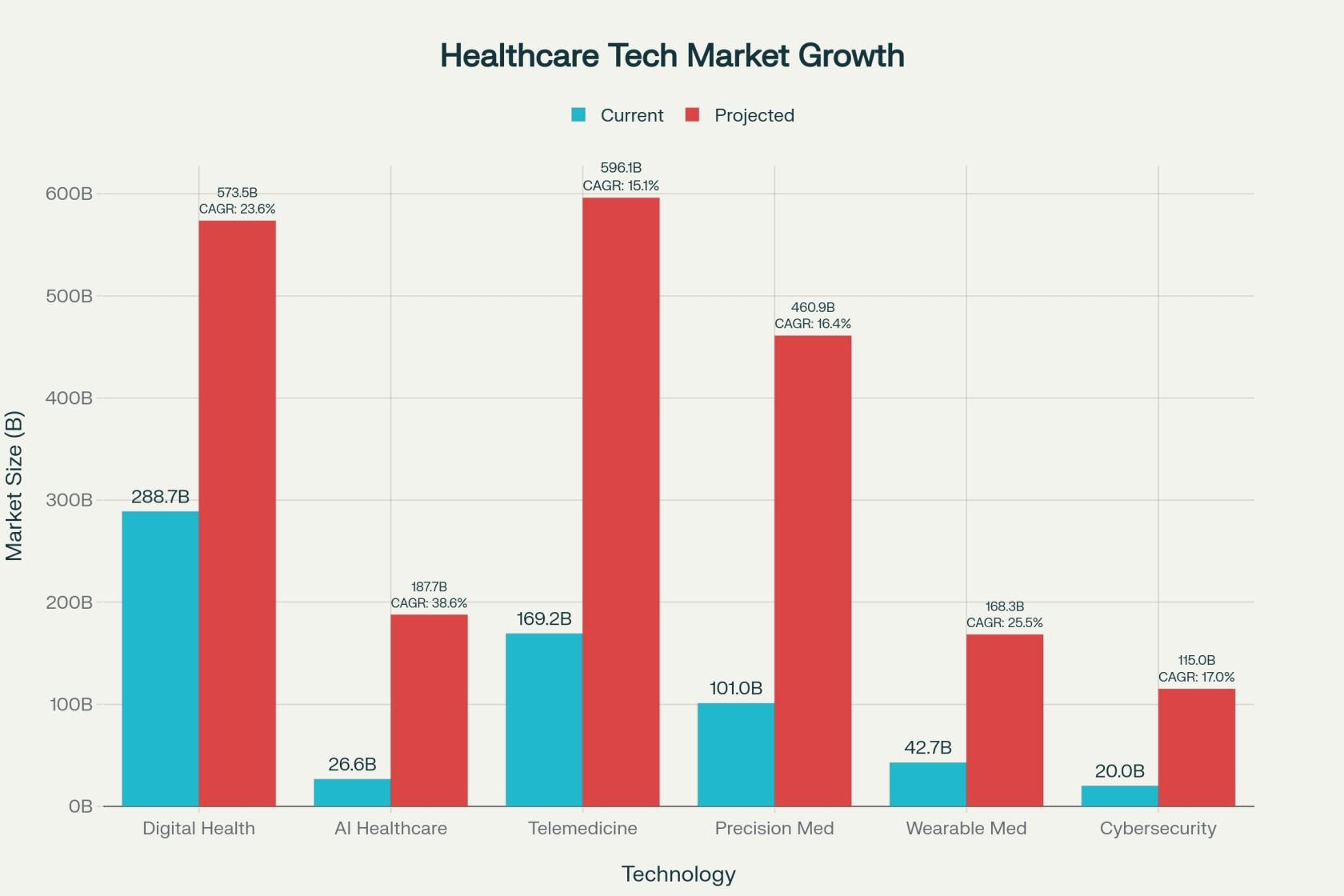
Artificial Intelligence is the most transformative force in healthcare, with the global AI healthcare market expanding from $26.57 billion in 2024 to $187.69 billion by 2030. The remarkable 38.62% CAGR with the current adoption statistics demonstrates a widespread implementation. Among them, there are 94% of healthcare providers, life science companies, and tech vendors using AI in some capacity.
The artificial intelligence technology's impact extends beyond automation. Reportedly, it was possible to achieve up to 90% accuracy in detecting cancers like breast and lung cancer, while reducing diagnostic errors by up to 30%. A separate Microsoft-IDC research indicates that 79% of healthcare organizations are presently utilizing AI technology, with ROI realized within 14 months. In perspective, they are generating $3.20 for every $1 invested!
Geographic Distribution and Specialization
North America dominates the race for AI healthcare implementation, accounting for over 54% of revenue in 2024. A huge chunk of the growth in this sector is particularly driven by medical imaging, where 76% of all AI-enabled medical devices are used in radiology. (Only authorized for sale in the US).
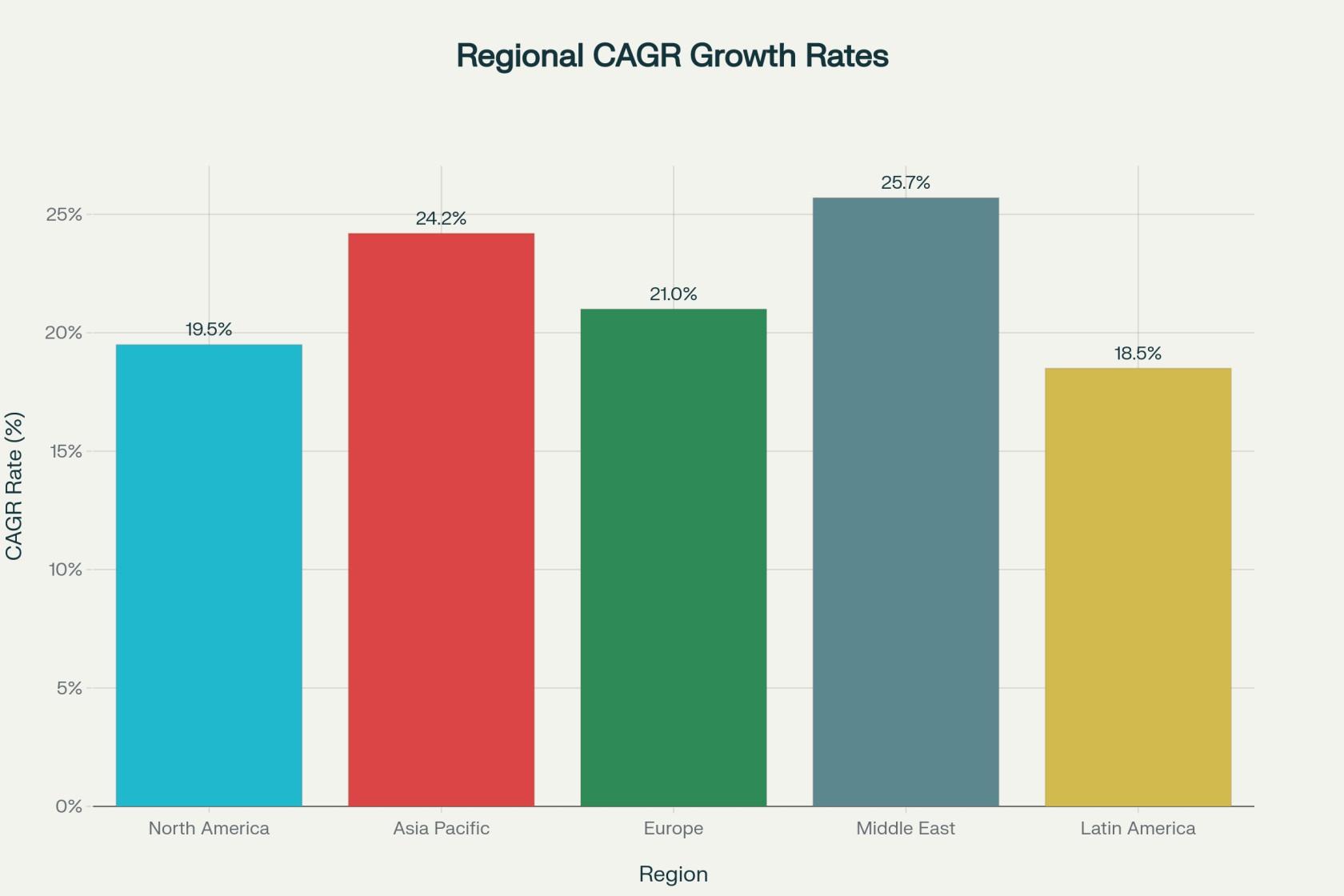
Alternatively, the Asia-Pacific regions are experiencing rapid expansion with an 8.5% CAGR by 2028, driven by government support and increasing research activities.
Secondary Trend Analysis: Digital Health Platform Integration
Comprehensive Market Expansion
The global digital health market is growing exceptionally, projected to reach $573.5 billion by 2030. From a $288.55 billion valuation in 2024, the 23.6% CAGR expansion encompasses telemedicine, mobile health applications, wearable technology, and digital therapeutics.
Apparently, creating an interconnected ecosystem of healthcare delivery is on the rise, with 350,000 health-related mobile applications available globally. Collectively, they support physical, mental, and lifestyle management needs. Additionally, the telemedicine segment specifically shows robust expansion, growing from $169.20 billion in 2025 to $596.08 billion by 2034 at a 15.06% CAGR.
Regional Implementation Patterns
The Asia-Pacific markets are experiencing the fastest digital health tech adoption growth, already valued at $72.28 billion in 2024. It is further projected to reach $498.91 billion by 2033 at a 24.2% CAGR. In the region, China leads with 25.31% market share in 2024, backed again by government initiatives that support digital health infrastructure development.
1. Precision Medicine and Genomics Revolution
Market Dynamics & Technology Adoption
A paradigm shift is being witnessed toward personalized treatment protocols, with the market expanding at a 16.4% CAGR. The growth of precision medicine from $100.95 billion in 2024 to $460.93 billion by 2034 is surpassed only by the genomics market, growing to reach $304.8 billion by 2035 at a 19.8% CAGR from 2025.
The Next-generation sequencing (NGS) holds 34.24% of the 2024 revenue base, acting as the foundation for companion diagnostics and genomic workflows. The technology's advancement makes it possible to rapidly analyse extensive genomic data. While also being cost-effective, it also facilitates a comprehensive exploration of disease genetics.
Clinical Applications & Outcomes
Applications of precision medicine extend across oncology, cardiovascular diseases, and genetic disorders. NGS combined with companion diagnostics plays a critical role in empowering precision diagnostics and therapeutics. The developments in regulatory frameworks additionally support increased clinical investigation data on disease heterogeneity.
2. Wearable Technology and Remote Monitoring
Market Expansion and Clinical Integration
The wearable medical devices market is expanding from $42.74 billion in 2024 to $168.29 billion by 2030 at a 25.53% CAGR. These wearable devices facilitate continuous monitoring of vital signs, glucose levels, and other critical health parameters> Their market adoption is critical in supporting chronic disease management for conditions affecting millions globally.
About 537 million adults were living with diabetes in 2021. This figure is expected to rise to 643 million by 2030 and 783 million by 2045, driving demand for continuous glucose monitoring and remote patient care solutions. In the United States, 30% of adults have accepted wearable medical devices as part of their healthcare regimen, with 46.3% agreeing to share recorded data with healthcare providers.
Technological Capabilities and Integration
Advanced wearable devices now incorporate AI-enabled analytics, real-time monitoring, and integration with electronic health records. In this behavior, the Asia Pacific region shows particular promise, with India's wearable medical devices market valued at $1.04 billion in 2024. What's better is that it's projected to reach $4.2 billion by 2033 at a 15.5% CAGR.
3. Healthcare Cybersecurity: Critical Infrastructure Protection
Threat Landscape and Market Response
Healthcare cybersecurity is gaining importance, with the market expanding from $20 billion in 2024 to $115 billion by 2035 at a 17.0% CAGR. The urgency stems from ever-escalating cyber threats, with over 22,000 security breaches occurring across diverse sectors in 2025. Among them, 1,710 incidents in the healthcare sector resulted in sensitive patient data exposure.
Ransomware attacks have specifically surged by 37% since 2024, while healthcare organizations encounter an average of 1,426 breach attempts every week. The Change Healthcare ransomware attack in February 2024 was particularly brutal. It compromised data for 100 million Americans, highlighting the sector's vulnerability and driving cybersecurity investment.
Regulatory Response and Investment Patterns
The Healthcare Cybersecurity and Resiliency Act, enacted in December 2024, modernizes HIPAA regulations and requires comprehensive incident response strategies. North America maintains the largest market share at 40.20%, driven by stringent regulatory compliance requirements and sophisticated threat environments.
4. IoT Healthcare Integration
Connectivity and Data Exchange
IoT in healthcare creates a required connectivity between medical devices, applications, and systems. The IoT or IoMT market is growing from $56.73 billion in 2024 to $464.45 billion by 2034 at a 23.4% CAGR. 74% of patients in the US used telehealth services through IoT healthcare in 2023, demonstrating widespread adoption on the patient side and systemic integrations.
The IoT in healthcare enables real-time monitoring, personalized treatment plans, remote consultations, and data-driven decision-making across healthcare ecosystems. However, 57% of IoT devices are vulnerable to medium or high-severity attacks, necessitating robust security frameworks for medical device protection.
5. Digital Mental Health and Therapeutics
Market Growth and Clinical Adoption
Digital therapeutics in mental health have reached $3.07 billion in 2024 and are projected to reach $15.16 billion by 2033 at a 19.6% CAGR. The broader digital mental health market grows, too, but slightly less, from $27.56 billion in 2025 to $50.45 billion by 2029 at a 16.3% CAGR.
19.86% of the total US population, approximately 50 million adults, were recorded to have experienced mental illness in 2022, compared to 19% in 2021. Thus, these figures are enough to conclude the driving demand for digital intervention solutions. Currently, the software-based digital therapeutics dominate the market, offering scalable, 24/7 accessible mental health support through mobile applications and AI-driven interventions.
6. Blockchain and Data Security Innovation
Distributed Healthcare Data Management
Blockchain technology in healthcare addresses data security, interoperability, and transparency challenges. Its market is expanding from $831.54 million in 2024 to $178.91 billion by 2034 at a 71.1% CAGR.
The technology's decentralized and encrypted nature provides enhanced security levels, making it attractive for healthcare organizations managing sensitive patient information.
Blockchain-based Electronic Health Records specifically show growth from $1.14 billion in 2024 to $15.07 billion by 2034 at a 29.8% CAGR. This growth is mainly driven by increasing demand for patient-centered, secure, and interoperable healthcare solutions.
Regional Analysis: Geographic Transformation Patterns
Asia-Pacific Digital Leadership
Backed by government initiatives, the Asia-Pacific region demonstrated the most aggressive healthcare technology adoption. On the path to achieving 24.2% CAGR growth through 2033, smartphones are significant market contributors for digital health infrastructure adoption.
Featuring a penetration rate of about 70% in major regions, the smartphone and tech adoption, sans expansion, is driven by supportive regulatory frameworks. Moreover, China leads the regional implementation with 25.31% market share, while India shows particular strength in telemedicine and wearable device adoption.
Ultimately, Healthcare IT outsourcing in the region reached $61.23 billion in 2024, and will grow to $115.02 billion by 2032 at an 8.2% CAGR.
Middle East Innovation Hub
The Middle East is emerging as a digital health innovation center, with market growth multiplying fivefold, from $10.93 billion in 2024 to $69.00 billion by 2033. Saudi Arabia's Vision 2030, the UAE's Health Strategy, and national digital transformation initiatives across the GCC are altogether boosting healthcare expenditure, reaching $135.5 billion by 2027.
Telemedicine is particularly growing in the MEA region, gaining $4.74 billion in 2024 and a projected $7.92 billion by 2029 at a 10.80% CAGR. Such growth is mainly supported by national e-health programs and virtual hospital initiatives.
Regulatory and Compliance Evolution
Adaptive Regulatory Frameworks
Healthcare regulatory environments are evolving to accommodate technological advancements for patient safety and data protection. The FDA's adoption of ISO 13485 for quality management represents the most essential update to US device quality standards in decades, taking effect on February 2nd, 2026.
Global Compliance Harmonization
Regulatory harmonization is rising across jurisdictions, with multi-jurisdictional compliance requirements becoming the benchmark standard for healthcare technology companies. The convergence of HIPAA, GDPR, and emerging privacy regulations has created complicated and complex compliance matrices, now requiring sophisticated data governance strategies.

Read more: Guide to Compliance & Ethics for Healthcare Providers
Investment & Economic Impact Analysis
Return on Investment Metrics
The returns on healthcare technology investments are pretty strong, with AI implementations providing nearly $3 or more for every $1 invested within 14 months. Sure, the timeline is a bit longer than what would satisfy most, but it's contributing in other ways.
For instance, the digital health startups secured $10.1 billion in funding across 497 deals in 2024. This is crucial to note because the secured deals from the previous year totaled $1.8 billion across 118 deals in Q4 alone.
Healthcare EBITDA is also estimated to increase at a 7% CAGR to $987 billion in 2028 from $676 billion in 2023. It must be noted that the growth will be driven by operational efficiency improvements and technology-enabled care delivery models.
Market Consolidation Trends
Mergers and acquisitions activities are intensifying as larger healthcare organizations are acquiring newer technology capabilities while smaller companies seek scalability. About 86% of healthcare organizations report extensive AI usage, with global healthcare AI market projections exceeding $120 billion by 2028.
Strategic Implications for Healthcare Leadership
Operational Transformational Requirements
Nine in 10 healthcare executives expect next-generation technology acceleration in 2025, with 70% listing technological investment as the top priority. Hence, the healthcare organizations must prepare for a comprehensive digital transformation in healthcare requiring infrastructure investment, workforce development, and cultural adaptation.
Competitive Positioning Considerations
The patient trust erosion in the US healthcare system is at its lowest in 24 years, according to the Americans. It is a positive development, since it creates opportunities for technology-enabled care delivery improvements.
Healthcare providers are resultantly adopting AI-driven predictive analytics, remote monitoring capabilities, and personalized treatment protocols to achieve operational efficiency improvements. As a result, they are also enhancing patient experience and clinical outcomes.
Conclusion
Healthcare's future will be defined by a large-scale digital transformation driven by the adoption of artificial intelligence to personalize medicine, achieve interoperability, and robust cybersecurity.
Progressive success in this new era will require hospitals and providers to modernize their infrastructure, upskill their workforce, and navigate evolving regulatory landscapes.
Rapid adoption in Asia-Pacific and the Middle East shows that leaders who act now to embrace these trends can deliver better patient outcomes and secure long-term competitive advantages.
Wondering where to start? Connect with the Ciphernutz team for a free 30-minute consultation!