How AI Integration Improves Clinical Outcomes in Modern Healthcare
Vijay Vamja
8-10 mins
Introduction
Healthcare systems today generate massive amounts of data, yet turning that data into timely and accurate decisions remains a challenge. From patient records and diagnostic reports to operational workflows, healthcare providers are expected to deliver faster, safer, and more personalized care with limited resources.
This is where artificial intelligence is moving from being an experimental technology to a practical enabler.
AI integration in healthcare is no longer about replacing clinicians or automating isolated tasks. It is about supporting medical professionals with insights, improving efficiency across systems, and enabling smarter decision-making at every level.
When implemented correctly, AI helps healthcare organizations reduce manual effort, improve accuracy, and respond more effectively to patient needs.
As healthcare continues to evolve, AI is becoming a foundational layer that connects data, systems, and people. Understanding its role is essential for organizations looking to build scalable, future-ready healthcare systems.
Why AI Matters in Modern Healthcare?
Modern healthcare faces increasing pressure from rising patient volumes, complex data environments, and growing expectations for quality care. Traditional systems struggle to keep pace with these demands, often leading to inefficiencies, delays, and clinician burnout.
AI addresses these challenges by helping healthcare teams process information faster and act with greater confidence. AI-powered systems can analyze large datasets in real time, identify patterns that may go unnoticed, and support clinicians with data-backed insights.
This leads to quicker diagnoses, better treatment planning, and more consistent outcomes. Beyond clinical care, AI also plays a critical role in streamlining administrative tasks such as scheduling, documentation, and resource planning.
By reducing repetitive work and improving operational visibility, AI allows healthcare professionals to focus more on patient care. For organizations, this means improved efficiency, better use of resources, and the ability to scale services without compromising quality. This practical value is why AI has become an essential part of modern healthcare systems.
How AI Improves Clinical Decision-Making?
Clinical decision-making is no longer limited to what a clinician can manually review in a short window of time. As patient data grows in volume and complexity, AI helps bring clarity by organizing information, highlighting risk factors, and supporting decisions with real-world evidence without interrupting clinical judgment.
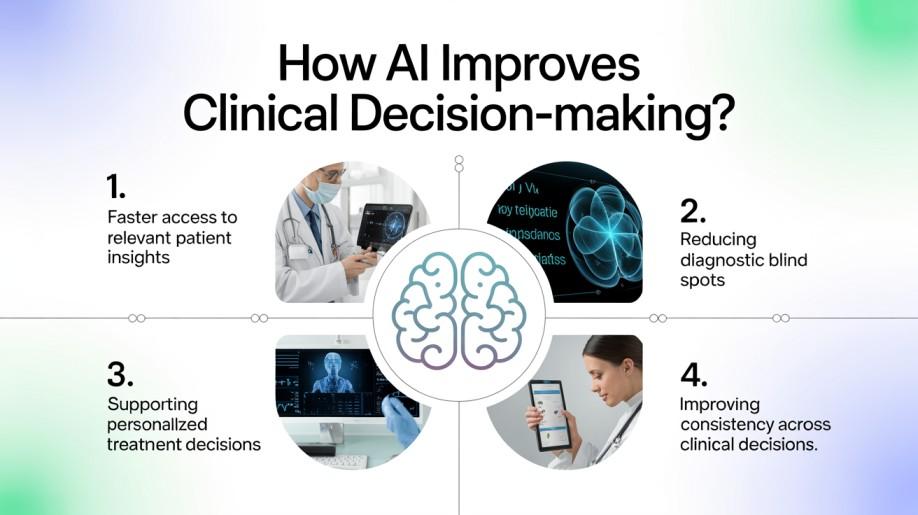
1. Faster Access to Relevant Patient Insights
In many healthcare settings, critical patient information is scattered across multiple systems. AI helps consolidate this data and present it in a way that is immediately useful. Instead of searching through lengthy records, clinicians can quickly see summaries, alerts, and trends that matter most for the current case.
This speed becomes especially valuable in time-sensitive situations, where delayed access to information can directly affect outcomes.
2. Reducing Diagnostic Blind Spots
Some conditions are difficult to identify early because symptoms are subtle or easily missed. AI systems analyze patterns across lab results, imaging, and historical cases to flag potential issues that may not be obvious at first glance.
This doesn’t replace clinical expertise. It adds a second layer of analysis that helps clinicians reassess assumptions, validate findings, and reduce the risk of oversight, particularly in complex or high-volume environments.
3. Supporting Personalized Treatment Decisions
Treatment decisions are rarely one-size-fits-all. AI helps clinicians consider a broader set of variables, such as patient history, previous responses to treatment, and comparable cases, before finalizing a care plan.
Rather than offering rigid recommendations, AI provides context that allows clinicians to adjust treatments based on how individual patients are likely to respond. This leads to more informed decisions and greater flexibility as patient conditions change.
4. Improving Consistency Across Clinical Decisions
Healthcare teams often vary in experience, workload, and available resources. AI helps bring consistency by applying the same data-driven logic across cases, reducing variations caused by incomplete information or time pressure.
This consistency is particularly useful in large healthcare organizations where standardizing decision quality is as important as improving individual outcomes.
Read more: AI LLMs Models for Clinical Decision Support
AI’s Impact on Day-to-Day Clinical Workflows
Clinical workflows are where most inefficiencies in healthcare quietly accumulate. Small delays in documentation, fragmented patient information, and constant system switching may seem manageable individually, but together they disrupt care delivery and drain clinical time.
AI addresses these issues at the workflow level, improving how tasks are completed rather than adding another layer of complexity.
1. Reducing Manual Documentation and Data Entry
Documentation remains one of the biggest time sinks for clinical teams. AI-assisted tools help capture clinical notes, organize patient records, and update systems with minimal manual input. Instead of spending hours entering data after consultations, clinicians can rely on intelligent systems that structure information accurately as care is delivered.
This reduction in manual effort not only saves time but also improves record quality by minimizing inconsistencies and missing details.
2. Improving Information Flow Across Care Teams
Patient care often involves multiple specialists, departments, and handoffs. AI helps keep information aligned by ensuring that updates, observations, and decisions are reflected across systems in near real time. Care teams spend less time verifying information and more time acting on it.
When data flows smoothly, collaboration improves and the risk of miscommunication during transitions of care is significantly reduced.
3. Supporting Clinicians During High-Volume Workloads
In busy clinical environments, workload pressure can affect focus and decision quality. AI supports clinicians by prioritizing tasks, flagging urgent cases, and reducing unnecessary system interactions. This support becomes especially valuable during peak hours, emergencies, or staffing shortages.
By easing cognitive and operational load, AI helps clinicians maintain efficiency without compromising care quality.
Case Study: How AI Integration Solved Healthcare Org Needs with 500+ Employees
4. Creating More Time for Patient Interaction
The most meaningful impact of AI on daily workflows is often indirect. By removing friction from routine processes, AI gives clinicians more time to engage with patients. Conversations become less rushed, follow-ups are better managed, and care feels more personal.
Over time, this shift contributes to better patient experiences and a more sustainable working environment for healthcare professionals.
Transforming Healthcare Operations Through Intelligent Automation
Healthcare operations often slow down due to manual processes, disconnected systems, and repetitive administrative work. Intelligent automation simplifies these processes by handling routine tasks in the background and reducing operational friction.
AI-powered automation improves consistency across scheduling, billing, and records management. Tasks are completed faster and with fewer errors, even during high-volume periods. This allows teams to focus on exceptions and decision-making instead of routine execution. Read more: Automate Appointment Scheduling With n8n.
By connecting operational data across systems, automation also improves visibility into capacity and resource usage. Healthcare organizations can plan better, respond faster, and scale operations without adding unnecessary complexity or workload.
Redefining Patient Interaction and Care Delivery Using AI
Patient interaction has moved beyond phone calls and in-person visits. Today, patients expect quick responses, clear updates, and consistent communication throughout their care journey. AI helps healthcare organizations meet these expectations by improving how information is delivered and how care is coordinated.
AI-powered tools enable timely responses to common patient queries, appointment updates, and follow-up reminders. Routine communication is handled efficiently without overwhelming care teams, while patients stay informed without delays or confusion.
Care delivery is also extending beyond traditional clinical settings. AI supports remote monitoring and virtual care by tracking patient data, identifying early warning signs, and prompting timely intervention when needed. This allows providers to stay connected with patients even after they leave the clinic or hospital.
By reducing communication gaps and supporting continuous care, AI helps create a more responsive and patient-focused healthcare experience. The result is better engagement, improved adherence to care plans, and higher patient satisfaction, without increasing operational strain.
Challenges of Adopting AI in Modern Healthcare
Adopting AI in healthcare involves more than introducing new technology. Organizations must address technical, data-related, and human challenges to ensure AI delivers real value rather than adding complexity.
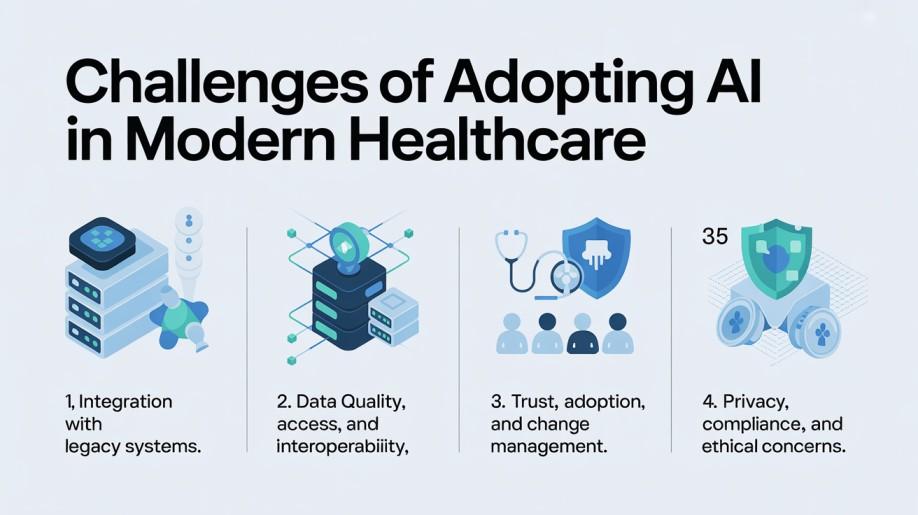
1. Integration With Legacy Systems
Many healthcare systems rely on legacy infrastructure that was not built to support AI-driven workflows. Integrating modern AI solutions into these environments often requires system upgrades, process changes, or custom integrations, which can slow implementation and increase costs.
2. Data Quality, Access, and Interoperability
AI depends on reliable and well-structured data, but healthcare data is often fragmented across multiple platforms. Inconsistent records, missing information, and limited system interoperability can weaken AI performance and reduce trust in its outputs.
3. Trust, Adoption, and Change Management
Even well-designed AI tools can fail if clinicians and staff are not confident using them. Resistance often comes from lack of transparency, limited training, or fear of over-reliance on automation. Successful adoption requires clear communication, practical training, and positioning AI as a support tool rather than a replacement.
4. Privacy, Compliance, and Ethical Concerns
Healthcare organizations must also navigate strict data privacy regulations and ethical considerations. Ensuring secure data handling, regulatory compliance, and responsible AI use is critical to minimizing risk and maintaining patient trust. Read more: Compliance & Ethics in AI.
How Healthcare Providers Can Approach AI Integration Strategically?
A strategic approach to AI integration services helps healthcare providers avoid isolated implementations and short-term wins. Instead of treating AI as a standalone upgrade, organizations that align technology with business and clinical goals are better positioned to achieve long-lasting impact. This is where experienced technology partners like Ciphernutz play a key role in guiding structured, outcome-focused AI adoption.
Step 1: Identifying High-Impact Use Cases Before Implementation
Successful AI initiatives begin with identifying problems worth solving. Healthcare providers should focus on areas with high manual effort, operational bottlenecks, or decision-making gaps, such as clinical documentation, patient coordination, scheduling inefficiencies, or resource planning.
By prioritizing use cases with measurable outcomes, providers can validate AI’s value early. Strategic guidance from partners like Ciphernutz helps organizations assess feasibility, align use cases with existing workflows, and avoid investing in solutions that lack real-world relevance.
Step 2: Selecting the Right Technology and Integration Partners
AI integration depends not only on the tools chosen but also on how well they fit within existing systems. Healthcare providers must evaluate technologies based on interoperability, data readiness, scalability, and compliance requirements.
Equally important is selecting integration partners who understand healthcare workflows and regulatory constraints. Ciphernutz IT Services brings this domain-aware approach by helping providers design AI solutions that integrate smoothly with current infrastructure while remaining secure and compliant.
Step 3: Scaling AI Solutions Responsibly Across the Organization
Once AI solutions demonstrate value at a pilot level, scaling should be intentional rather than rushed. Expanding AI across departments requires consistent training, performance monitoring, and governance to maintain trust and reliability.
With structured frameworks and ongoing support from experienced partners like CipherNutz, healthcare organizations can scale AI solutions responsibly, ensuring long-term adoption without disrupting clinical or operational stability.
Conclusion: AI in Modern Healthcare
AI is no longer an emerging concept in healthcare, it is becoming a practical foundation for improving care delivery, operational efficiency, and clinical decision-making. When integrated thoughtfully, AI helps healthcare providers manage complexity, reduce manual effort, and respond more effectively to patient needs.
However, the real value of AI lies not in adoption alone, but in how strategically it is implemented. Organizations that focus on clear use cases, responsible scaling, and alignment with existing workflows are better positioned to achieve sustainable results. Working with experienced technology partners such as Ciphernutz enables healthcare providers to navigate this transformation with clarity, confidence, and long-term impact.
As healthcare software development continues to evolve, AI will play a critical role in shaping more connected, efficient, and patient-focused environments. Providers that invest in practical, well-governed AI integration today will be better prepared to meet the demands of tomorrow.