Real Automation Implementations of Vertical AI in SaaS: A Guide
Vijay Vamja
7-8 mins
Developing custom IT solutions for businesses is nothing new, but the arrival of vertical AI in SaaS is truly the biggest innovation for software automation. A SaaS development company in today's age must harness the utilities and advantages of vertical artificial intelligence - otherwise, they risk becoming obsolete.
This blog will, therefore, offer more depth into the business use cases of vertical AI in SaaS and its future trends. From presenting the purpose of vertical AI to its counterpart differences and a brief technical implementation guide - this blog covers all the gaps!
Understanding Vertical AI vs. General AI
General AI (not to be confused with Generative AI) exists to offer broad solutions to industries and consumers alike. It is also one of the widely-known types of AI that can perform calculations with grand comprehension processing and other abilities.
On the other hand, Vertical AI is built specifically for particular sectors to offer everyday automation and predictive abilities, at the least. Furthermore, a vertical AI agent is simply a digital entity or mode of delegation to carry out particular tasks.
By using domain-specific data and algorithms, Vertical AI already delivers higher accuracy, efficiency, and relevance than general AI to numerous industries worldwide.
Real Industry-Specific Use Cases of Vertical AI in SaaS
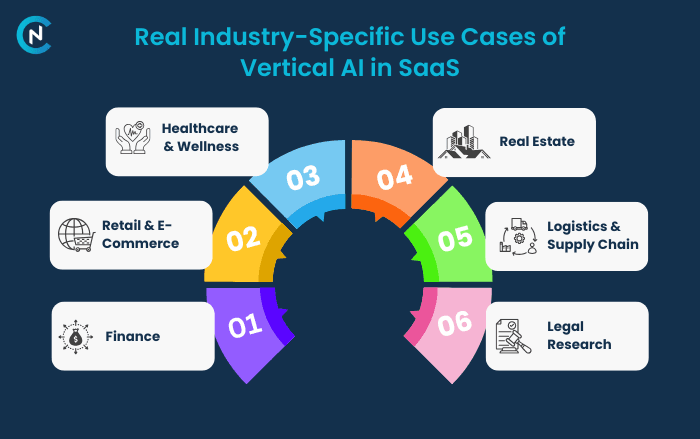
Several companies are today either considering or already developing their own vertical AI agents to solve their business challenges. Among them, the following four industries have long begun to reap the impact of vertical AI agents in SaaS.
1. Healthcare & Wellness
Medical Imaging & Diagnostics
- Zebra Medical Vision: Reduce radiology errors by 40% using AI to analyze medical images and detect diseases earlier.
- Aidoc: Provide decision support to radiologists in real-time by flagging acute abnormalities.
- Viz.ai: Accelerate stroke detection and treatment coordination through automatic CT scan analysis.
Clinical Decision-Making
- UpToDate: Incorporate AI to deliver evidence-based clinical recommendations tailored to patient profiles.
- Innovaccer: Unify patient data across systems and generate AI-powered care insights and risk predictions.
- PathAI: Assist pathologists with more accurate cancer diagnoses through AI-enhanced tissue analysis.
Administrative & Operational Efficiency
- Olive: Automate repetitive healthcare administrative tasks, reducing claim processing time and errors.
- Qventus: Optimize hospital operations through AI-powered predictions for patient flow and resource allocation.
- Notable Health: Automate physician documentation using natural language processing to reduce administrative burden.
Patient Engagement & Monitoring
- Wellframe: Delivers personalized care plans and monitoring through AI-driven mobile platforms.
- Biofourmis: Provide AI-powered remote patient monitoring to detect deterioration before clinical symptoms appear.
- AliveCor: Uses AI to analyze ECG data from portable devices to detect cardiac abnormalities.
2. Retail & E-Commerce
Automate Inventory & Supply Chain Management
- Blue Yonder: Uses AI to predict demand patterns and optimize inventory levels across complex retail networks
- Relex Solutions: Provides AI-powered forecasting specifically designed for retail replenishment and markdown optimization
- Celect: Optimizes merchandise distribution across stores based on local demand patterns, now belongs to Nike.
Hyper-Personalize Shopping Experiences
- Dynamic Yield: Creates individualized shopping experiences with AI that adapt product recommendations on the fly.
- Nosto: Delivers personalized product recommendations based on browsing behavior and purchase history.
- Bluecore: Automates personalized marketing campaigns based on individual shopper intent and product interactions.
Enhance Visual Search & Discovery
- Syte: Enables visual search, allowing shoppers to find products by uploading images.
- Clarifai: Powers visual recognition for retailers to improve product discovery and search accuracy.
- Lily AI: Translates product images into detailed attribute tags that match customer emotional context.
Smart Pricing Optimization
- Competera: Provides retail-specific dynamic pricing optimization through competitive analysis
- Perfect Price: Uses AI to analyze price elasticity across product categories in retail environments
- Eversight: Offers AI-powered promotional planning designed specifically for retail operations
Customer Service
- Heyday: Creates retail-specific chatbots that understand product catalogs and shopping intent.
- Gorgias: Provides e-commerce-specific helpdesk automation with integrated order management.
- Gladly: Unifies customer service channels with commerce data for personalized retail support.
3. Finance
Risk Assessment & Underwriting
- Upstart: Uses AI to analyze non-traditional credit factors for more inclusive loan underwriting.
- Zest AI: Provides credit underwriting models that increase approval rates while reducing risk.
- Affirm: Powers point-of-sale lending decisions with AI risk assessment tailored to retail finance.
Fraud Detection & Security
- Feedzai: Specializes in financial fraud detection across banking and payment platforms.
- Forter: Offers real-time fraud prevention specifically designed for e-commerce transactions.
- BioCatch: Uses behavioral biometrics to detect account takeover attempts in banking applications.
Wealth Management & Advisory
- Betterment: Delivers automated portfolio management with AI-driven rebalancing and tax strategies.
- Wealthfront: Provides AI-powered financial planning and investment management.
- SigFig: Optimizes investment portfolios while integrating with existing banking infrastructure.
Regulatory Compliance
- ComplyAdvantage: Uses AI to screen transactions against financial crime risks and sanctions lists.
- Hummingbird: Automates anti-money laundering investigations with finance-specific workflow tools.
- Shield: Monitors communication data for market abuse and compliance violations in trading environments.
Financial Operations
- AppZen: Automates expense auditing and compliance with finance-specific AI.
- Vic.ai: Provides AI-powered accounting automation for financial close processes.
- Auditoria: Delivers AI-based automation for financial back-office operations.
4. Real Estate
Property Valuation & Analysis
- HouseCanary: Provides AI-powered property valuations with predictive analytics for future price movements.
- Zillow's Zestimate: Offers automated valuation models that incorporate property-specific data and market trends.
- Skyline AI: Uses machine learning to analyze investment properties and identify mispriced assets.
Market Intelligence
- Reonomy: Delivers property intelligence with ownership details and market analytics for commercial real estate
- Cherre: Connects disparate real estate data sources for comprehensive market insights
- Enodo: Analyzes multifamily properties to determine optimal rent pricing and amenity values.
Property Management
- Latchel: Automates maintenance coordination with AI-powered vendor management
- MeetElise: Provides AI leasing assistants that handle inquiries and schedule showings
- AppFolio AI: Engages with prospective tenants through natural language conversations
Transaction Management
- Redfin: Uses AI to identify potential buyers for specific properties and optimize showing schedules.
- OJO Labs: Connects homebuyers with personalized property recommendations through AI assistants.
- Doma: Streamlines title search and underwriting with AI-powered document analysis.
Smart Building Solutions
- Facilio: Optimizes building operations through AI-powered facilities management
- Buildium: Uses AI to forecast maintenance needs and optimize property operations
- Measurable: Provides ESG (environmental, social, governance) analytics for real estate portfolios.
5. Logistics & Supply Chain Management
Route Optimization & Transportation
- Project44: Provides real-time visibility and predictive ETAs across all transportation modes
- FarEye: Optimizes last-mile delivery routes while adapting to real-time constraints
- Convoy: Matches freight with carriers using machine learning to eliminate empty miles
Warehouse & Inventory Management
- Shopify's Flexport: Uses AI to synchronize inventory across warehouses and predict optimal stock distribution
- Locus Robotics: Coordinates autonomous mobile robots through AI-powered fleet management
- 6 River Systems: Optimizes warehouse workflows with intelligent picking algorithms
Demand Forecasting
- o9 Solutions: Provides AI-powered demand planning specifically calibrated for supply chain dynamics.
- Llamasoft (Coupa): Models complex supply chains to predict demand patterns and optimize inventory.
- Relex Solutions: Offers forecasting tools tailored for retail supply chain environments.
Supply Chain Visibility
- FourKites: Tracks shipments across modes with predictive ETAs and risk analysis
- Shippeo: Provides real-time transportation visibility with AI-powered delay predictions
- Overhaul: Monitors supply chain risk with automated exception management
Sourcing & Procurement
- LevaData: Analyzes market conditions to optimize sourcing decisions for manufacturing
- Keelvar: Automates sourcing events with AI-powered optimization for complex categories
- Suplari (Microsoft): Identifies spending patterns and suggests optimization opportunities
6. Legal Research
Contract Analysis & Management
- Kira Systems: Extracts and analyzes information from contracts using machine learning models trained on legal documents.
- Evisort: Automatically categorizes, tracks, and analyzes contracts across their lifecycle.
- DocuSign Insight: Identifies clauses and provisions across contract portfolios with industry-specific analysis.
Legal eDiscovery & Research
- ROSS Intelligence: Provides AI-powered legal research results that understand natural language legal questions.
- Casetext CARA: Analyzes legal briefs to find relevant cases and authorities not yet cited.
- vLex: Performs AI-assisted legal research functionalities across multiple jurisdictions with concept-based searching.
- Everlaw: Uses AI to identify relevant documents and patterns in litigation data.
- Disco: Provides AI-powered document review and case management for litigation.
- Reveal: Offers AI tools specifically designed for investigations and compliance reviews.
Practice Management
- Clio: Incorporates AI for legal billing optimization and client intake automation.
- Smokeball: Uses AI to track billable activities and automate document creation.
- Time by Ping: Automatically captures attorney time through AI activity monitoring.
Legal Document Drafting Automation
- Neota Logic: Creates automated legal applications without coding.
- BRYTER: Enables no-code automation of legal workflows and document generation.
- JusticeText: Automatically transcribes and analyzes evidence for public defenders.
Apart from these vertical SaaS AI implementation examples, telecom giants and other enterprises are also concurrently exploring their holistic uses of vertical artificial intelligence solutions.
Once they finalize a roadmap or seek help from an AI-SaaS development company, vertical AI agents operating within workforce teams will likely become an everyday reality.
Business Impact and ROI of Vertical AI in SaaS
Adoption of vertical AI in SaaS systems leads to several measurable benefits, not excluding:
- Cost Savings: AI-driven automation reduced operational expenses by 30% or greater
- Efficiency Gains: Optimization of workflows enhances productivity and decision-making.
- Revenue Growth: Personalized AI solutions improve customer engagement, increasing conversion rates.
- Scalability: AI-powered SaaS platforms can adapt to business growth without extensive infrastructure changes.
Technical Implementation Guide for Vertical AI in SaaS
Step 1: Identify Business Needs
Analyze the pain points of your business and define objectives to empower with AI.
Step 2: Pick the Correct AI Model
Choose the relevant LLM models, such as GPT-4, Google Gemini, and IBM Watson, depending on the specific requirements of your SaaS platform.
Step 3: Manage Data Collection & Processing
Gather and obtain industry-specific datasets and then preprocess them for corrections for AI training.
Step 4: AI Model Integration
Leverage SDKs and APIs for smooth yet intelligent AI implementation with your SaaS application.
Step 5: Deployment and Continuous Monitoring
Use cloud-based AI monitoring tools to ensure consistent performance and make real-time adjustments.
Although these steps should suffice for creating your own vertical AI agent in a SaaS system, it is not the only way to create them. A generative AI development company can offer many other types of Vertical AI tools for SaaS businesses, and other Custom AI solutions for SaaS businesses.
Do you want to learn more about each process at every step or other types? Connect with our team!
Ethical and Compliance Considerations
It is incredibly necessary to first carefully consider the scope and use of AI technology, from choice to implementation to regular adoption.
Even after the AI capabilities are integrated with your SaaS systems, you must monitor their performance to ensure they aren't breaching any ethical compliances. Similarly, it must also be ensured that your vertical AI in the SaaS solution does not support non-ethical activities or processes.
There are four easy ways to ensure AI ethics and compliance when empowering your SaaS with AI:
- Bias Mitigation: Train AI on diverse datasets to reduce algorithmic biases.
- Data Privacy: Implement encryption and secure storage solutions.
- Regulatory Adherence: Comply with industry standards such as HIPAA for healthcare and GDPR for data protection.
- Transparency: Provide explainable AI outputs to build user trust and healthy communication.
Future Trends and Predictions for Vertical AI in SaaS
The innovations in various uses of AI are evolving equally or quicker than the modern advancements in AI technology. For businesses and consumers, such developments are revolutionary because they herald progress and growth of digital experiences infrastructure.
Following are some common predictive future trends for Vertical AI in SaaS.
1. No-Code & Low-Code AI Development
Vertical AI-powered SaaS platforms will leverage no-code AI platforms to deploy niche automation without needing technical expertise.
2. Hyper-Automation & AI-Driven Decision Making
Automate repetitive tasks and also assist executives in making complex strategic decisions through advanced predictive analytics.
3. AI-Augmented Customer Experience
Offers real-time support with personalized chatbots to improve customer satisfaction across connected SaaS platforms.
4. AI-Powered Security & Risk Management
Proactively detect threats and automate risk assessments & management to improve and enhance modern cybersecurity.
Final Words
Obtaining custom AI SaaS solutions from an AI development company can be transformative for your business and its long-term goals. When you hire a Generative AI developer, please inquire about various LLMs and their limitations to understand which solution fits best with your business model.
Whatever you choose, remember that AI will grow exponentially (+$50 trillion) by 2030 and ahead. Hence, it is recommended that you invest in modern AIs with a vision to scale your Vertical AI in SaaS systems.